
Content advised and reviewed by the experts at MGI Consulting, updated in accordance with the Law on Enterprises 2020, Decree 168/2025/ND-CP, Circular 68/2025/TT-BTC, and the latest implementing legal documents in force in 2026.
Under the 2026 administrative reform, the processing time for company incorporation dossiers has been significantly shortened through the National Business Registration Information System.
Even so, statistics show that the proportion of legal entities having their tax code suspended by state management agencies for violating post-licensing inspection rules is on the rise, mainly stemming from breaches of capital declaration obligations and delays in setting up the initial accounting system.
Therefore, to help your business operate lawfully, MGI provides detailed guidance based on the most hands-on experience gained from preparing company incorporation dossiers for our clients.
Summary of the core company incorporation procedure in 2026:
- Preparation stage: Determine the company name, a lawful head office address, the charter capital, and apply the VSIC 2025 economic industry codes.
- Registration stage: Submit the dossier online through the National Public Service Portal using a VNeID electronic identification account.
- Legal-entity completion stage: Have the company seal engraved, register a public digital signature, open a payment account, and complete the initial tax declaration procedures.
6 Key Pieces of Information to Clearly Determine Before Submitting a Company Incorporation Dossier
Before you begin drafting the dossier, your business needs to agree on and carefully prepare the 6 items below. These are not merely mandatory fields in the registration form; they are decisions that directly affect the company’s operations and legal compliance later on.

Company Name
By law, a company name consists of two elements: “Type of enterprise + Proper name.”
The proper name must not be identical to, or confusingly similar to, the name of an enterprise already registered nationwide. In addition, a company name must never use the appellation of a state agency or people’s armed forces unit, or words and symbols that violate the historical traditions, culture, ethics, and fine customs of the nation.
So before choosing a name, you should run a preliminary search for the intended name on the National Business Registration Portal to check availability. It is advisable to prepare 2-3 name options (including a Vietnamese name, an English name, and an abbreviated name) in case your preferred name has already been registered.
Head Office Address
The head office address must be clearly identified within the territory of Vietnam using a 3-tier structure: House number/street name, Commune/Ward, Province/City.
Important note: Current law strictly prohibits the use of an apartment (intended for residential purposes) as a company head office. You may only locate your head office in office buildings or other lawful commercial premises as prescribed.
Business Lines:
An enterprise has the right to freely conduct any business that the law does not prohibit, but when registering, you must “encode” your business ideas into level-4 codes under the Vietnam Standard Industrial Classification (VSIC).
Pay particular attention to “conditional business investment lines.” The amended Law on Investment 2025 has added new lines (such as data exchange platform services, etc.).
A clear distinction is needed:
- The Department of Finance issuing the Enterprise Registration Certificate is merely the step of recognizing the legal entity.
- For conditional business lines, you are required to obtain an additional “sub-license” (an operating eligibility license) from the relevant specialized Ministries after incorporation before you are allowed to operate. If you skip this step, the business will be deemed to be operating unlawfully.
Charter Capital
Charter capital is the total value of assets that members/shareholders commit to contribute, and it is the basis for determining financial liability as well as the business license tax.
Capital contribution deadline: The law requires members to fully contribute the committed capital within 90 days from the date the license is granted. If the capital is not fully contributed, the business is required to carry out procedures to reduce its capital.
MGI’s advice: Although the law does not set a minimum level for most business lines (except those requiring legal capital), you should not declare capital that is too low (which affects your credibility in bidding) or too high compared to your actual capacity (creating the risk of large asset liability if the business incurs losses).
Personal Legal Documents:
You need to prepare certified copies of the ID Card/Citizen ID Card/Passport of the legal representative and of the capital-contributing members/shareholders (if any).
In particular, check whether the permanent residence information on the card matches the national population database, especially if your locality has recently undergone changes to its administrative boundaries following a merger.
This is mandatory information used to verify the identity of the owner and the legal representative, and the legal status of the enterprise.
Contact Information (Phone Number, Email)
This is the official communication channel between state agencies and the enterprise, and it will also be published on the electronic business bulletin.
MGI’s advice: As soon as the dossier is approved, this information will be publicly displayed. To avoid your personal phone number being disturbed and your private life affected by a flood of advertising or scam calls, you should consider using a dedicated phone number and email exclusively for the company’s business.
The 4-Step Company Incorporation Process: Detailed Guide & Updated with the Latest Regulations
The company incorporation procedure has now been strongly digitized, but it comes with stricter requirements on information transparency. Below is a standardized 4-step roadmap for registering a company with 100% Vietnamese capital, updated with the latest regulations effective from July 1, 2025.
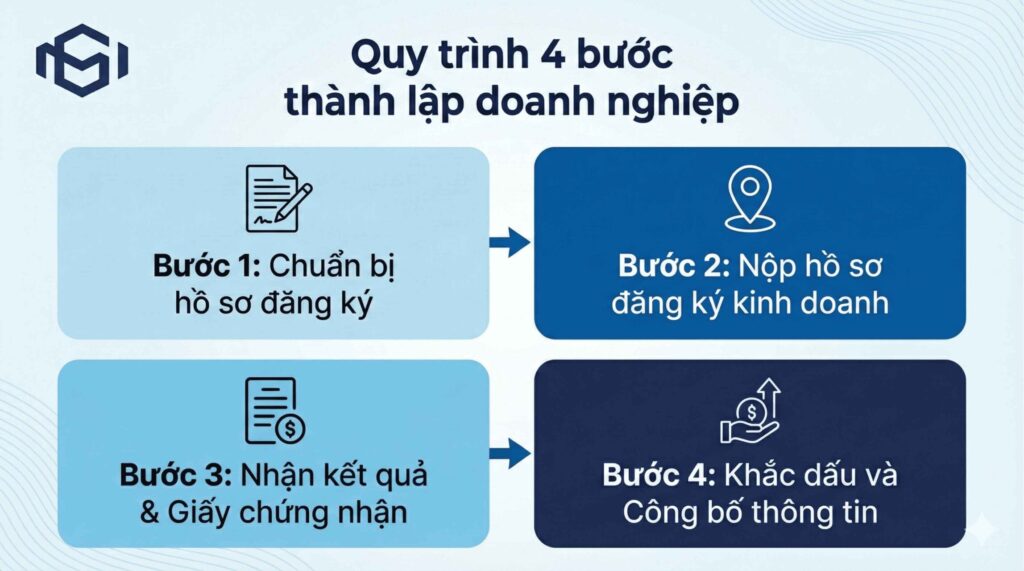
Step 1: Prepare the registration dossier (Note the new forms)
This is the most important step, determining whether your dossier is accepted or not. From July 1, 2025, the business registration authority only accepts dossiers drafted using the new set of forms (issued together with Circular 68/2025/TT-BTC). Using the old forms (under Circular 01/2021) is no longer valid.
The standard dossier components include:
1. Application for enterprise registration: Use the new form corresponding to each type of enterprise (single-member LLC, multi-member LLC, or joint-stock company).
2. List of members/founding shareholders: Fully declare the information of the capital-contributing individuals/organizations.
3. Personal legal documents (valid copies):
- Vietnamese citizens: Citizen ID Card (chip-embedded).
- Foreigners: Passport.
- Contributing organizations: Establishment decision/Enterprise Registration Certificate + Letter of authorization for the representative.
4. List of beneficial owners (new mandatory requirement):
- This is a core change aimed at preventing money laundering. You are required to declare the information of the individual who actually holds controlling power over the enterprise (even if they are not directly named on the documents).
- The enterprise has a continuous obligation to update this information and provide it to state agencies upon request.
Step 2: Submit the business registration dossier
Today, submitting a paper dossier in person has been almost entirely replaced by online submission in major cities.
Receiving authority: The Business Registration Office under the Department of Finance where the enterprise is headquartered.
Preferred submission method: Submit the dossier electronically via the National Business Registration Portal.
Process: Create a business registration account -> Enter data into the electronic form -> Upload the scanned signed dossier -> Authenticate with a public digital signature or an electronic identification account (VNeID).
Step 3: Receive the results & the Certificate
By law, the dossier processing time is 03 working days from the date a complete and valid dossier is received; however, state agencies are currently reorganizing their apparatus and some regulations are being amended and updated, so processing times may take longer than usual.
Results:
- If the dossier is valid: You will be granted the Enterprise Registration Certificate (ERC).
- If the dossier needs revision: You will receive a Notice requesting amendment or supplementation of the dossier (the handling officer will clearly state the reasons for the request).
Important note on the electronic version: From October 25, 2025, the business registration authority has begun returning the results of administrative procedures in electronic form. This result file bears the digital signature of the licensing authority and has legal validity equivalent to a paper document. Enterprises can store and use this file for banking and tax transactions without needing the traditional paper copy.
Step 4: Engrave the seal and disclose information
After obtaining the Enterprise Registration Certificate, you need to carry out the post-licensing steps to fully establish your legal-entity status:
Company seal:
- Under the Law on Enterprises 2020, the enterprise has full authority to decide on the form, quantity, and content of its seal.
- You no longer need to carry out the “seal specimen notification” procedure with the police authority as before. The enterprise may have a physical seal engraved at seal-engraving establishments or use a digital signature as a form of electronic seal.
Information disclosure: Enterprise registration information must be publicly disclosed on the National Portal within 30 days. This step is usually integrated when you submit the dossier online (if the disclosure fee has been paid).
Tasks to Do Immediately After Incorporation to Avoid Penalties
Receiving the Enterprise Registration Certificate is only the beginning. To bring your company into lawful operation and avoid the risk of having your tax code locked or incurring administrative fines in the very first month, you need to complete the 6 mandatory procedures below:

Put up the company signboard
This should be done immediately. The tax authority will inspect (either unexpectedly or periodically) to verify whether the enterprise actually operates at the registered address.
Requirement: The signboard must be hung in an easily visible location (the frontage), without obstructing traffic or emergency exits.
Mandatory content: Company name, Tax code, Head office address. You may add a phone number, email, or website to increase brand recognition.
Legal risk: If the tax authority inspects and finds no signboard, the enterprise may be recorded as “not operating at the registered address” and have its tax code locked.
Purchase a digital signature (Token)
In the digital era, a digital signature carries legal validity equivalent to the seal and handwritten signature of the legal representative.
A digital signature is mandatory for carrying out online administrative procedures such as: electronic tax declaration and payment, social insurance, customs, signing online contracts, and issuing electronic invoices.
-> You should purchase it from providers licensed by the Ministry of Information and Communications.
Open a bank account and the new 2025 payment rules
Opening a corporate account helps separate the company’s assets from personal assets and is also a condition for tax deductibility.
Procedure: Bring the business license, the seal, and the legal representative’s Citizen ID Card to the bank to open the account.
Important rule from July 1, 2025: To be eligible for VAT deduction and to count expenses as deductible when calculating corporate income tax, input invoices with a value of VND 5,000,000 or more (instead of VND 20 million as before) must be paid via bank (bank transfer). Therefore, owning a corporate account early is extremely urgent.
Register and issue electronic invoices
Today, 100% of enterprises must use electronic invoices instead of paper invoices.
Process: After obtaining a digital signature, you need to choose an electronic invoice software provider and complete the registration to use it with the tax authority. Only once the tax authority approves may you issue invoices to customers.
MGI’s advice: Implement this early so as not to disrupt the company’s sales and revenue-collection process.
Initial tax declaration
This is the procedure that makes the direct tax administration authority aware of you. The enterprise must submit its initial tax declaration dossier to the managing Tax Sub-Department or Tax Department.
The dossier usually includes:
- The business license tax declaration form (usually submitted online).
- The decision appointing the Director/Chief Accountant (or the person in charge of accounting).
- Registration of the accounting method and the fixed-asset depreciation method.
Method: Depending on the locality, some places receive paper dossiers at the “one-stop” desk, while others require online submission via thuedientu.gdt.gov.vn.
Register the salary scale and internal labor regulations
To protect employees’ rights and ensure the reasonableness of salary expenses in the eyes of the tax authority, the enterprise needs to complete its labor records.
Salary scale: This is the basis for agreeing on the salary level in the labor contract and for paying social insurance.
Contracts & internal regulations: Establish rules on working hours, rest, discipline, etc. Having complete labor contracts and salary/bonus regulations is a prerequisite for salary expenses to be accepted by the tax authority as “reasonable expenses” at year-end tax finalization.
5 Practical Lessons and Mistakes to Avoid When Incorporating a Company (Updated 2025)
There is a big gap between theory and practice. Some details that seem trivial can, if not carefully calculated, cost you time and money to fix the consequences. Below is a summary of 5 practical lessons and the most common legal traps that business owners should keep in mind in 2025.
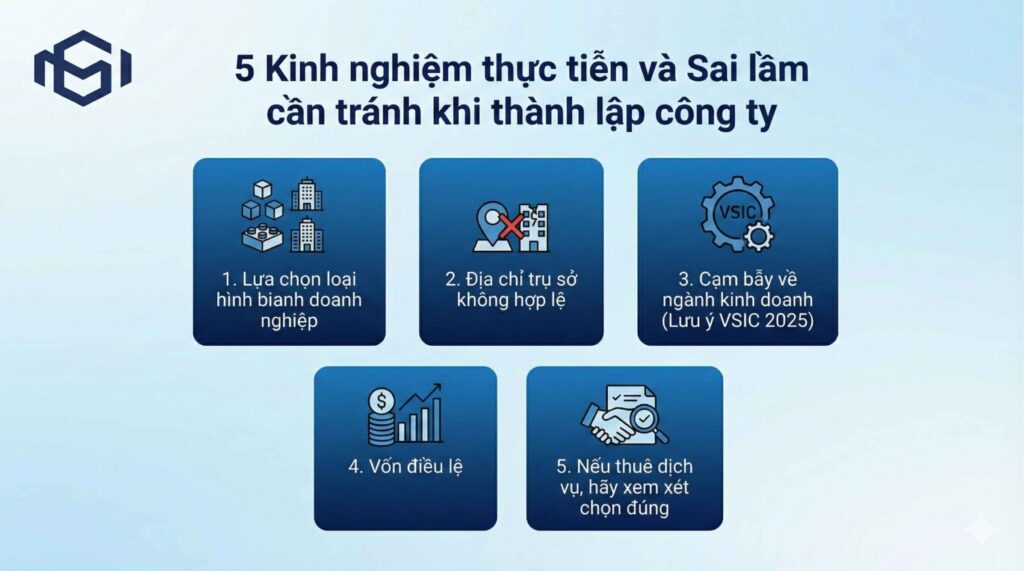
Choosing the type of enterprise
The type of enterprise determines your organizational structure, ability to raise capital, and level of risk.
If there is only 1 individual/organization: The only and most optimal choice is a single-member LLC. You have full authority over all activities, a streamlined structure, and are liable only within the scope of your contributed capital.
If there are 2 members: You are required to choose a multi-member LLC. This model suits close, mutually trusting partners, and internal management is less complex than a joint-stock company.
If there are 3 or more members: You may consider between a multi-member LLC or a joint-stock company.
MGI’s advice: Choose a joint-stock company if you aim for an IPO or need to raise capital flexibly from many unfamiliar investors. However, be mentally prepared for a more complex governance and reporting process.
Invalid head office address
A classic mistake that gets a dossier rejected immediately is: Using an apartment or officetel address (with residential function) as the head office. Current law does not accept an apartment address as a business head office.
Traps regarding business lines (Note VSIC 2025)
Registering business lines is not simply a matter of “writing down anything you like.” 2025 marks a major change to the industry code system.
Common mistake: Many dossiers are asked to be revised because they still apply the old industry codes (under VSIC 2018).
Important note: From November 15, 2025, registration must comply with the new Vietnam Standard Industrial Classification (VSIC 2025).
Classification:
- Ordinary business lines: You can operate as soon as registration is complete.
- Conditional business lines: After obtaining the business license, you are required to obtain an additional “sub-license” (such as a food safety and hygiene permit, a security and order permit, etc.) before you may officially operate.
Charter capital
Many business owners tend to inflate the charter capital or set it too low without anticipating the consequences.
- Declaring too high: You will face the risk of the tax authority scrutinizing your financial capacity and of bearing very large asset liability if the company incurs losses/goes bankrupt.
- Declaring too low: This reduces the credibility of your capability profile when bidding or working with large partners.
MGI’s advice: Set a capital level appropriate to your actual scale of operations and the financial capacity of the members.
If hiring a service, make sure you choose the right one
If you are not confident in preparing the dossier yourself and decide to hire a service provider, be cautious to avoid “losing money and getting nothing.” A reputable consulting firm should meet the following standards (rather than just being cheap):
Transparent fees: A full package quote from the start, with a commitment to no “hidden fees” or “travel fees.”
In-depth expertise: The ability to handle complex sub-licenses and to advise on accurate industry codes.
Lifetime support: Having a post-incorporation support policy (accounting, tax, trademark protection, etc.), because a business’s journey only begins after the license is obtained.
FAQ: The 10 Most Common Legal Questions Before Incorporating a Company
In the course of advising founders, we notice certain questions that come up again and again. Below are detailed answers to the most common issues surrounding company incorporation procedures, updated with the latest legal regulations for 2025.
1. Who is entitled to establish an enterprise? Is a qualification required?
Regarding eligibility: Under the Law on Enterprises 2020 and its amendments and supplements (such as in Law 76/2025/QH15), every individual and organization has the right to establish an enterprise, except for prohibited cases such as: state cadres, civil servants, and public employees, military officers, minors, persons with limited civil act capacity, or persons being prosecuted for criminal liability.
Regarding qualifications: The law does not require a qualification when you register to establish a company (even for the Director position). However, if you conduct a “conditional business line” (such as a clinic, law firm, auditing, construction design, etc.), you are required to hold a valid practicing certificate when applying for the specialized operating license (sub-license).
2. Can foreigners open a company in Vietnam?
Foreigners fully have the right to contribute capital, purchase shares, or establish an enterprise in Vietnam. However, the process is more complex than for domestic investors because it must additionally comply with the Law on Investment (an Investment Registration Certificate – IRC must be obtained) and WTO commitments.
3. How much capital is needed to start?
The current Law on Enterprises does not stipulate a minimum capital level (except for lines requiring legal capital, such as banking, insurance, real estate business, etc.).
Note: You self-declare and take responsibility for this capital within 90 days. You should not declare “virtual” capital that is too high (asset liability risk) or too low (affecting business credibility).
4. Can I establish a company in the city if my household registration is in my hometown?
Absolutely yes. Establishing a company does not depend on your permanent household registration. You may have a household registration in Hanoi but open a company in Ho Chi Minh City or any other province, as long as you have a lawful head office address there.
5. Can an apartment be used as a company head office?
Absolutely NOT if it is an apartment with a residential function (under the Law on Housing).
Exception: You may only locate your head office in an apartment if it is a mixed-use building (Officetel) and the area you rent is confirmed by the developer as having a commercial/office function in the construction records. A private house (landed house) is accepted but must have a clear house number.
6. I don’t have an actual office yet; can I rent a “virtual office”?
Permitted. The Law on Enterprises 2020 (Article 42) defines the head office as a point of contact with a determined address, phone number, and email. The law does not prohibit the virtual office model (renting an address for business registration). This is a cost-optimal solution for startups in their early stages.
7. What happens if a company name is identical to another company’s?
The national business registration system will automatically reject your application if your proper name is identical to, or confusingly similar to, an enterprise registered earlier (nationwide).
MGI’s experience: A company name consists of: “Type + Proper name.” You cannot “get around the law” by merely changing the type (for example, if “ABC LLC” already exists, you cannot name yours “ABC Joint-Stock Company”).
8. What taxes and fees must an enterprise pay?
Immediately after incorporation, the enterprise will be subject to tax administration with 4 basic financial obligations:
- Business license tax: A fixed annual payment based on charter capital. (Good news: Under Decree 22/2020/ND-CP, newly established enterprises are exempt from the business license tax in the first year).
- Value-added tax (VAT): Paid quarterly or monthly (usually 10% or 8% depending on policy).
- Corporate income tax (CIT): Usually 20% on after-tax profit (payable only when there is a profit).
- Personal income tax (PIT): Withheld and paid on behalf of employees (if salaries are paid).
9. If I later want to do business in another field, are the procedures difficult?
The procedure is very simple and quick.
When first incorporating, you don’t need to try to register “everything.” Later, when you expand your business, you simply carry out the “Notice of changes to enterprise registration content” procedure to add industry codes. The dossier is submitted online and resolved within 3 working days.
10. Should I use a full-package service or prepare the dossier myself?
If you have the time and understand the regulations: You can certainly do it yourself to save on service costs.
If you want to save time and avoid legal risks: You should use a service. Professional firms will help you get accurate industry-code advice (avoiding the old VSIC 2018 codes), draft a standard charter, and, most importantly, handle post-licensing matters (tax, electronic invoices, digital signatures, etc.) so you can focus entirely on your business.
Closing Words from MGI
Starting a business is a long journey, full of excitement but also plenty of challenges. Understanding the legal process well is great, but you don’t necessarily have to do it all alone. Instead of spending hours studying new forms or worrying about misapplying VSIC 2025 industry codes, spend that valuable time developing your business strategy.
Let MGI be your first companion on legal matters, helping you handle every procedure from A to Z as a full package at the most optimal cost. An accurate start will be a solid launchpad for future success.
👉 See MGI’s company incorporation services & pricing here: Business incorporation consulting service