
Circular 20/2026/TT-BTC, issued by the Ministry of Finance, officially takes effect on March 12, 2026, providing detailed guidance on the 2025 Law on Corporate Income Tax and Decree 320/2025/ND-CP. The Circular introduces major changes to how deductible expenses are determined, documentation for invoice-less purchases, revenue recognition timing, and tax incentive policies — all applicable immediately to the 2025 tax finalization period.
Every tax finalization season brings enormous pressure on business owners and accounting teams. Worries about supporting documents being disallowed, expenses not being recognized, or inadvertently incurring heavy administrative penalties are ever-present.
Understanding these risks, this article not only updates you on the latest regulations under Circular 20/2026/TT-BTC, but also serves as a practical strategy to help you systematize your entire tax documentation and maximize your business’s financial interests.
The Impact of Circular 20/2026/TT-BTC
Circular 20/2026/TT-BTC completely replaces the previous regulations under Circular 78/2014 and Circular 96/2015. The new regulations apply immediately to the 2025 tax period, setting stricter standards for documentation transparency and eligibility conditions for tax incentives.
Issued to guide the implementation of the Law on Corporate Income Tax No. 67/2025/QH15 and Decree 320/2025/ND-CP, Circular 20/2026 has officially become the guiding compass for all corporate income tax declaration activities from this year onward.
A key point to note is that although the Circular officially takes effect on March 12, 2026, its provisions are applied retroactively to the 2025 tax period. The provisions on non-cash payment documentation and capital transfer income, however, already took effect earlier, on December 15, 2025.
Failing to keep up with or misinterpreting this document could result in your business paying unnecessary back taxes.
Deductible Expenses – Avoiding the Risk of Disallowance
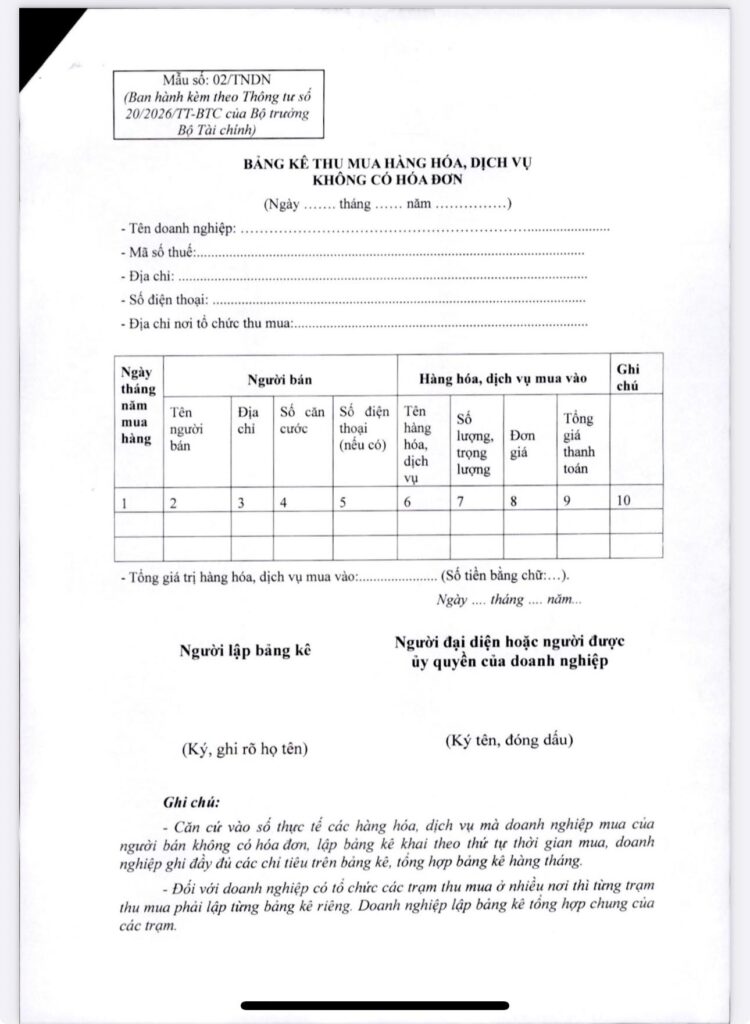
To be recognized as a valid expense, every expenditure a business makes must be accompanied by legitimate supporting documents. In particular, purchasing goods from small individual traders or agricultural producers requires a detailed purchase list along with payment vouchers.
The greatest risk during tax audits typically lies in the area of deductible expenses. Circular 20/2026/TT-BTC establishes very clear boundaries to protect businesses operating in good faith, while tightening the loopholes that could otherwise be exploited.
A Way Out for Purchasing Goods Without Invoices
If your business regularly purchases agricultural, forestry, or aquaculture products directly from farmers, or buys scrap materials and handicraft products directly from producers, the biggest obstacle is that sellers cannot issue a value-added tax (VAT) invoice.
To solve this problem, the law allows you to record these amounts as valid expenses if the proper documentation is in place: you must prepare a purchase list using Form No. 02/TNDN, combined with transparent payment vouchers. This is a legitimate lifeline that helps manufacturing and processing businesses optimize a substantial portion of their input costs.
Tighter Regulations on Employees Purchasing on Behalf of the Company
A very common practice is having employees advance their own money to purchase supplies and equipment. The new Circular sets extremely strict requirements: for expenses of 5,000,000 VND or more incurred by an employee purchasing on the company’s behalf, the business must have a clear, written authorization policy in place.
In addition, the cash flow must show an unbroken chain through non-cash payment methods, including both the employee’s bank transfer to the supplier and the company’s bank transfer reimbursing the employee.
Welfare and National Defense-Security Expenses
Good news for businesses that prioritize social responsibility and workforce development. Expenses for national defense and security education tasks, support for the activities of Party organizations and socio-political unions within the enterprise, as well as vocational training costs for employees, continue to be recognized as deductible expenses, provided they are fully supported by approval decisions and confirmation documents from the relevant specialized authorities.
Making the Most of Corporate Income Tax (CIT) Incentives
Circular 20/2026/TT-BTC expands tax exemption and reduction opportunities for investment projects in high technology, renewable energy, and regions with disadvantaged socio-economic conditions, helping businesses build sustainable financial leverage.
Alongside tighter expense management, the government has also opened up broader pathways to encourage investment. To take advantage of these incentives, businesses need to proactively review whether their business sector qualifies for priority treatment.
If you are investing in high technology, developing renewable energy, or locating your factory in a region with disadvantaged socio-economic conditions, you are fully entitled to apply preferential tax rates, potentially including a full tax exemption during the initial years of operation, as well as loss carry-forward deductions against taxable income in subsequent periods. Establishing a sound revenue allocation structure now will help you maximize the benefits of these policies.
An Action Roadmap for Businesses
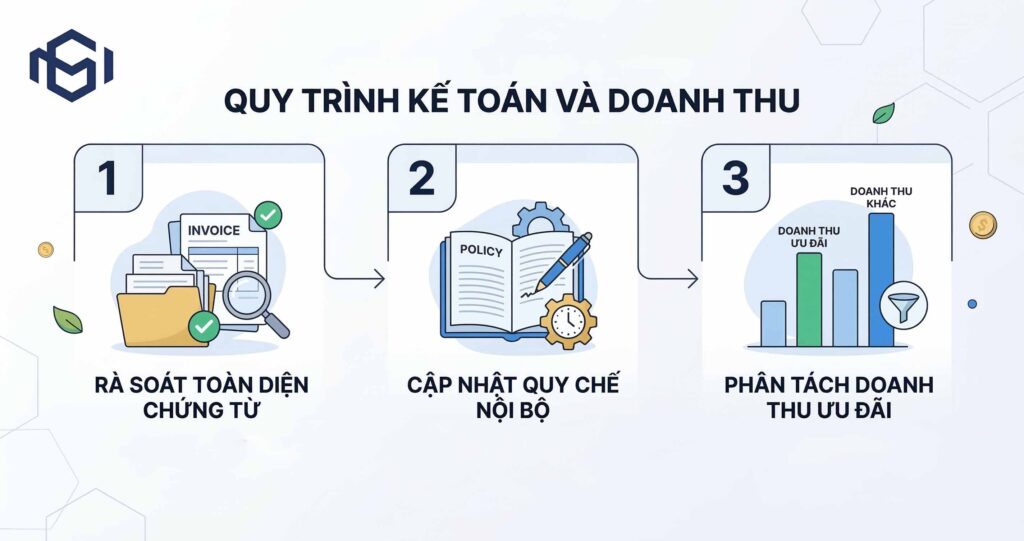
To ensure 100% compliance with Circular 20/2026/TT-BTC and prepare for the upcoming 2025 tax finalization period, business owners should take the following 3 steps right away:
- Conduct a comprehensive document review: Check all expenses that lack an e-invoice, ensuring that Form 02/TNDN purchase lists have been fully completed.
- Update internal policies: Immediately issue a purchasing authorization policy for employees and tighten the non-cash payment process for invoices of 5,000,000 VND or more.
- Separate incentivized revenue: If the business operates across multiple sectors, accountants must record revenue from tax-incentivized activities separately from ordinary business activities, to avoid the risk of losing those benefits during a tax inspection.
Frequently Asked Questions (FAQ)
Q1. Circular 20/2026/TT-BTC takes effect on March 12, 2026 — so which regulations apply to figures from the start of 2025 up to that date?
This Circular applies to the entire 2025 tax period. This means that when you file your 2025 CIT finalization return (the filing deadline typically falls at the end of March 2026), you must apply the expense and revenue reconciliation rules exactly as guided under Circular 20/2026/TT-BTC.
Q2. From what point do the non-cash payment regulations take effect?
The provisions on non-cash payment documentation requirements, as well as those related to income from capital transfers, officially took retroactive effect on December 15, 2025 (the date Decree 320/2025/ND-CP came into force).
Q3. If I purchase large-value agricultural products from farmers, is there a cap on the expense amount for the purchase list?
Current law does not set a cap on the total value of invoice-less agricultural purchases. However, every transaction must be genuine, with the seller’s full signature on the Form 02/TNDN purchase list and valid payment vouchers. If a tax authority inspection uncovers falsified figures, the business will be liable for the full amount of the tax shortfall plus administrative penalties.
MGI’s tax declaration service provides a comprehensive financial risk control solution, helping businesses stay accurately updated with the latest regulations automatically. Instead of navigating an enormous accounting workload on your own, hand over the entire burden of bookkeeping reconciliation to MGI’s Tax Declaration Service.
Our team of legally knowledgeable specialists will build a solid protective barrier around your cash flow, ensuring that every document submitted to state authorities achieves absolute accuracy.