
In the course of doing business, many enterprises find themselves in a situation where their tax code (TIN) is switched to the status “Not Operating at the Registered Address.” This means the company’s tax code has been locked, and the business must go through the tax code restoration procedure in order to resume operations. In practice, the tax management system does not automatically lock a tax code if the enterprise fully complies with the regulations. This situation typically arises because the enterprise is late in filing tax returns, or because the tax authority is unable to reach the business at its head office.
Having a locked tax code causes serious consequences: the company effectively exists in name only and cannot fulfill obligations tied to the tax code, such as filing tax returns, submitting periodic reports, updating business registration details, or issuing invoices to customers. Therefore, whether you want to maintain normal operations or need to reopen it to proceed with dissolution, restoring the tax code is a mandatory procedure that should be carried out as soon as possible
What Does “Locking/Closing” a Tax Code Mean?
This refers to the status in which a tax code is no longer valid for use in the tax authority’s electronic database. This status is divided into two different groups:
Deactivation of the Tax Code (Permanent Tax Code Closure)
This procedure is carried out when an enterprise, organization, or individual ceases to exist (dissolution, bankruptcy, or termination of business operations).
The tax code is closed permanently and cannot be reissued to any other entity. The taxpayer must fulfill all financial obligations before this step is carried out.
Taxpayer Has Stopped Operating but Has Not Completed the Tax Code Deactivation Procedure, or the Taxpayer Is Not Operating at the Registered Address (Temporary Lock)
This is the status commonly referred to as “locked.” The tax authority issues a written notice and updates this status in the system when:
- The tax authority determines that the taxpayer is not operating at the registered address.
- The taxpayer violates tax law to an extent that triggers enforcement measures, such as suspension of invoice use or locking of the tax code, to prevent further transactions.
Causes of Tax Code “Locking/Closing”
“Enforcement” Due to Violations at the Registered Address

This is the most common cause. When tax officials conduct periodic or surprise inspections of an enterprise’s actual operating status:
- No signboard displayed: Under current regulations, an enterprise must display a signboard at its head office. Failing to display a signboard, or having it obscured, leads tax officials to conclude that the enterprise is not present at that location.
- Office closed for an extended period: When tax officials make repeated verification visits and consistently find the office “closed,” with no staff on site, they prepare a verification record with the local authorities or the building management confirming that the enterprise is no longer operating there.
- Notices returned undelivered: When the tax authority sends documents (such as tax debt notices or requests to explain discrepancies in tax returns) by post, but the postal service returns them marked “no recipient.” After a notice is returned or sent via the electronic portal without receiving any response, the tax authority issues a notice inviting the enterprise to come and work with it. If the enterprise still fails to respond after more than 03 notices, the system will automatically switch the tax code status to “Not Operating at the Registered Address.”
- Late filing of tax returns: The enterprise fails to submit tax returns (VAT, corporate income tax, personal income tax) for one or more periods without a valid reason.
- Failing to pay tax liabilities on time (VAT, corporate income tax, business license fee, etc.)
- Many enterprises change their actual head office but only complete the procedure with the Department of Finance while forgetting to notify their directly managing tax authority (or vice versa). When the former tax authority reviews the file for transfer or checks the old address, it finds no trace of the enterprise and immediately issues a nationwide notice that the business has stopped operating.
The “Pending” Status After an Enterprise Has Voluntarily Initiated Dissolution or Left the Tax Code Closure Procedure Unfinished

In technical terminology, this is referred to as a temporary enforcement lock status of the tax code.
- This status appears when an enterprise voluntarily submits a dissolution application to the Department of Finance, and once the Department approves the step-1 dossier, the system pushes the data to the tax authority and the tax code switches to this status. Because tax debts remain outstanding, the tax authority cannot allow the tax code to be closed permanently (deactivated), so it is kept in this pending status for management purposes.
- Dissolution procedure started but abandoned midway: After submitting the dossier to the Department of Finance, many enterprises neglect to go to the tax authority to finalize the figures. Or, upon doing so, when the business owner sees how large the tax debt and late-payment penalties have become, they abandon the process altogether. The tax code then remains stuck in this status. The enterprise no longer has the right to conduct business, yet the tax debt remains outstanding and the late-payment interest keeps increasing every day.
- The enterprise has had its Business Registration Certificate revoked by a decision of the Department of Finance (due to legal violations, fraudulent dossiers, or ceasing operations for over 1 year without reporting). This case differs from voluntary dissolution, because restoring the tax code in this situation is extremely difficult.
Dissolution or Corporate Reorganization (Merger, Consolidation, Division)
This covers cases where the tax code is closed at the enterprise’s own voluntary request, when it no longer needs to operate or is changing its legal structure.
- Enterprise dissolution: The tax code undergoes the permanent deactivation procedure once the enterprise has completed its tax finalization obligations and settled all outstanding debts.
- Corporate reorganization (merger/consolidation): The tax codes of the merged companies, or of the former companies being consolidated, are closed so that obligations can be transferred to the new entity.
- Division/split of an enterprise: The tax code of the former company is deactivated so that new tax codes can be established for the resulting subsidiary companies after the division.
Consequences of Having a “Locked/Closed” Tax Code
The Enterprise Cannot Carry Out the Following:
Regarding invoice use: The taxpayer cannot issue or create VAT invoices or sales invoices in any form.
Regarding tax filing obligations: The eTax system will stop accepting all of the enterprise’s tax return and tax registration dossiers, including:
- VAT and personal income tax returns.
- Corporate income tax finalization dossiers and personal income tax finalization dossiers.
- Financial statements and their accompanying appendices.
Regarding updates to business registration information: Because the databases of the tax authority and the business registration authority are interlinked, the taxpayer cannot carry out procedures to amend the Business Registration Certificate on the National Business Registration Information System.
Regarding electronic transactions: The digital signature linked to a locked tax code will be rejected by the system when authenticating electronic tax payment transactions or tax refund dossier submissions.
Regarding import-export activities: Customs authorities will stop processing customs clearance for goods where the tax code is not shown as active in the national database.
Administrative Penalty Brackets Related to Tax Code Violations
Pursuant to Decree 125/2020/ND-CP on administrative penalties for tax and invoice violations:
- Penalties for late submission of corporate income tax, VAT, and personal income tax returns/reports, as well as business license fee declarations. Depending on the number of days of delay, the enterprise may be fined between VND 2,000,000 and VND 25,000,000;
- Penalties for late payment of the business license fee, VAT, personal income tax, and corporate income tax (if applicable).
Note: The penalty levels above apply to organizations (enterprises). For individual business households, the fine may be set at half the level applicable to organizations. Paying the fine is a prerequisite for the tax authority to consider the tax code restoration dossier.
Cases Eligible for Tax Code Restoration
- When a document annulling the license revocation is issued: Applies when the competent state authority issues a document annulling the decision to revoke the Business Registration Certificate or an equivalent license.
- When the enterprise changes its mind about dissolution: The taxpayer wishes to continue operating after having already submitted a dossier to deactivate the tax code, but at the time of the request, the tax authority has not yet issued the official Notice of Tax Code Deactivation.
- When the address-related violation has been remedied: Applies where the tax authority has issued a notice that the taxpayer is not operating at its registered address, but at the time of the request, the enterprise’s business license has not yet been revoked and the tax code has not yet been fully deactivated in the system.
- When the enterprise wants to dissolve: to complete the dissolution procedure, the enterprise must carry out tax finalization and settle its tax obligations with its directly managing tax authority. However, while the tax code is locked, the system blocks all tax-return filing and finalization actions. The enterprise must therefore first restore the tax code to “Active” status before it can submit a dossier requesting “Tax Code Deactivation” (dissolution).
Dossier and Procedure for Restoring the Tax Code for Enterprises
When you discover that your company’s tax code has been locked, follow the steps below to have the tax code reopened for your company:
STEP 1: Look Up and Determine the Legal Status of the Tax Code
Contact the tax official directly managing your file, or search on the General Department of Taxation’s website at http://tracuunnt.gdt.gov.vn/ to find out why the enterprise’s tax code was locked and how to remedy it.
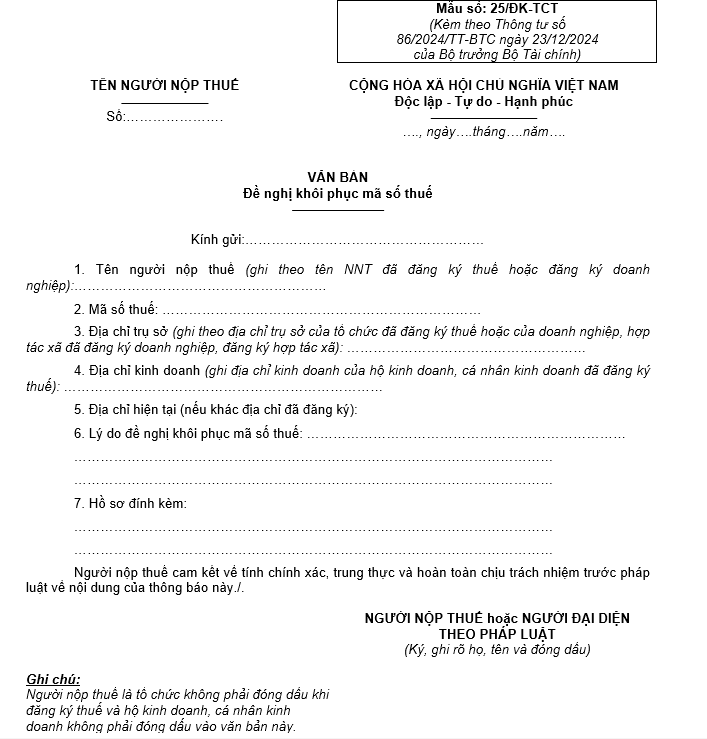
STEP 2: Submit an Official Letter Requesting Tax Code Restoration (Form No. 25/DK-TCT)
Once the enterprise fully understands the situation, it prepares and submits the tax code restoration dossier to its directly managing tax authority.
Dossier components:
- Written request for tax code restoration (Form No. 25/DK-TCT) issued under Circular 86/2024/TT-BTC.
- Power of attorney (if any);
- Other documents as required (if any).
Form No. 25/DK-TCT – Written Request for Tax Code Restoration: the latest form for requesting tax code restoration – Form No. 25/DK-TCT, issued together with Circular 86/2024/TT-BTC and officially effective from February 6, 2025.
STEP 3: Contact the Directly Managing Tax Official
This is the most important step. The enterprise needs to proactively work with its managing officer (from the Tax Inspection Team or the Taxpayer Management Team) to:
- Obtain detailed information on the violations that caused the tax code to be locked.
- Obtain the list of tax returns and tax reports still missing from the system.
- Reconcile the outstanding tax debt and late-payment interest accrued to date.
STEP 4: Submit All Required Returns and Reports, and Remedy Violations as Required by the Tax Authority
Within 10 working days from the date of receiving the tax code restoration request dossier, the directly managing tax authority will review the system and require the enterprise to complete any outstanding legal obligations. This is a prerequisite for the tax code to be reactivated. Specifically:
- Complete outstanding tax filings: The enterprise must fully submit any missing tax returns, tax finalization dossiers, and invoice usage reports for the period during which the tax code was locked.
- Settle all financial obligations: Pay in full the outstanding tax debt, late-payment interest, and any administrative fines under the tax authority’s penalty decisions before proceeding to the next restoration steps.
- On-site verification: The enterprise must display its company signboard at its head office. The tax authority will send a managing officer to conduct an inspection and prepare a Verification Record on the taxpayer’s operating status at the registered address.
Once the enterprise has fully remedied the violations and obtained a satisfactory address verification record, the tax authority will update the system and restore the tax code to active status.
FINAL STEP: Check and Maintain the Status After Restoration
After receiving the Notice of Tax Code Restoration (Form No. 19/TB-DK-TCT) and confirming that the system status has changed to “Active,” the enterprise should update its digital signature and e-invoices, and file tax returns on time.
To avoid having the tax code locked again in the future, the enterprise should ensure staff are always present at its head office, display a clear signboard, and regularly check its email and postal mail for correspondence from the tax authority.
CONCLUSION
A locked tax code not only paralyzes current business operations but also leaves a lasting “black mark” on the enterprise’s legal record over the long term. The restoration process requires thorough knowledge of administrative procedures, accounting data, and the skill to explain matters to the tax authority. Any mistake in preparing the dossier can prolong the waiting time, causing significant economic damage and harming the business’s reputation with its partners.
Instead of struggling with these complex procedures on your own, let MGI Consulting accompany you. With a team of experienced experts, we are committed to processing your dossier quickly and accurately, helping your enterprise eliminate legal risk and return to normal operations as soon as possible.
Don’t let delays disrupt your business opportunities. Contact MGI Consulting now for detailed guidance on the restoration process and to receive our best-value quote.
CONTACT US FOR IMMEDIATE ADVISORY SUPPORT
If your enterprise needs support restoring its tax code or advice on corporate legal procedures, please connect with MGI’s professional team through the following channels:
- Hotline / Zalo (24/7 Support): 0868 433 717
- Dossier Submission Email: tuvandautu.mgi@gmail.com
An MGI specialist will respond and propose a course of action for you within 30 minutes.