
When you begin turning a business idea into reality, choosing the legal form of the enterprise is always a milestone that founders must weigh carefully.
In Vietnam today, the Limited Liability Company and the Joint Stock Company are the two most common types, each with distinct characteristics in terms of capital structure, internal governance, and the ability to raise finance.
This article by MGI provides a comprehensive comparison of the Limited Liability Company and the Joint Stock Company based on the latest legal regulations, helping you clearly identify the advantages and disadvantages of each model and make the most accurate investment decision.
What Is a Limited Liability Company (LLC)?
A limited liability company is not specifically defined under enterprise law, but it can simply be understood that an LLC is a form of enterprise that includes the single-member limited liability company and the multiple-member limited liability company (two or more members). Specifically:
- Single-member LLC: This is an enterprise owned by a single organization or individual. The company owner is liable for the company’s debts and other property obligations only to the extent of the charter capital contributed.
- Multiple-member LLC (two or more members): This type has from 02 to 50 members, which may be organizations or individuals. The members are liable for the enterprise’s debts and other property obligations only to the extent of the capital they have contributed to the enterprise (except in certain special cases). The transfer of a member’s capital contribution is restricted and must comply with specific legal provisions.
What Is a Joint Stock Company (JSC)?
According to Clause 1, Article 111 of the Law on Enterprises 2020 (amended and supplemented in 2025), a joint stock company is a type of enterprise in which:
- The charter capital is divided into equal portions called shares.
- Shareholders are individuals or organizations that own shares. There must be a minimum of 03 shareholders, with no limit on the maximum number. Shareholders are liable for the enterprise’s debts and other property obligations only to the extent of the capital they have contributed to the enterprise.
- The profit that shareholders receive from owning shares is called dividends.
- A joint stock company can raise capital by issuing shares.
Comparison Between an LLC and a Joint Stock Company
| Legal criterion | Multiple-member LLC (two or more members) | Joint Stock Company | Legal basis (current Law on Enterprises) |
|---|---|---|---|
| Owning members | Minimum of 02 members; Maximum of no more than 50 members. | Minimum of 03 shareholders; No limit on the maximum number. | Clause 1, Article 46 Point b, Clause 1, Article 111 |
| Charter capital structure | Divided into non-standardized capital contributions (not required to be equal). | Divided into equal portions called shares. | Clause 1, Article 46 Point a, Clause 1, Article 111 |
| Raising capital | May issue bonds; Not entitled to issue shares. | Entitled to issue shares, bonds, and other types of securities. | Clause 4, Article 46 Clause 3, Article 111 |
| Capital transfer | Restricted: The pre-emptive right of existing members applies. | Freely transferable (except for certain restrictions on founding shareholders during the first 3 years). | Article 52 Article 127 |
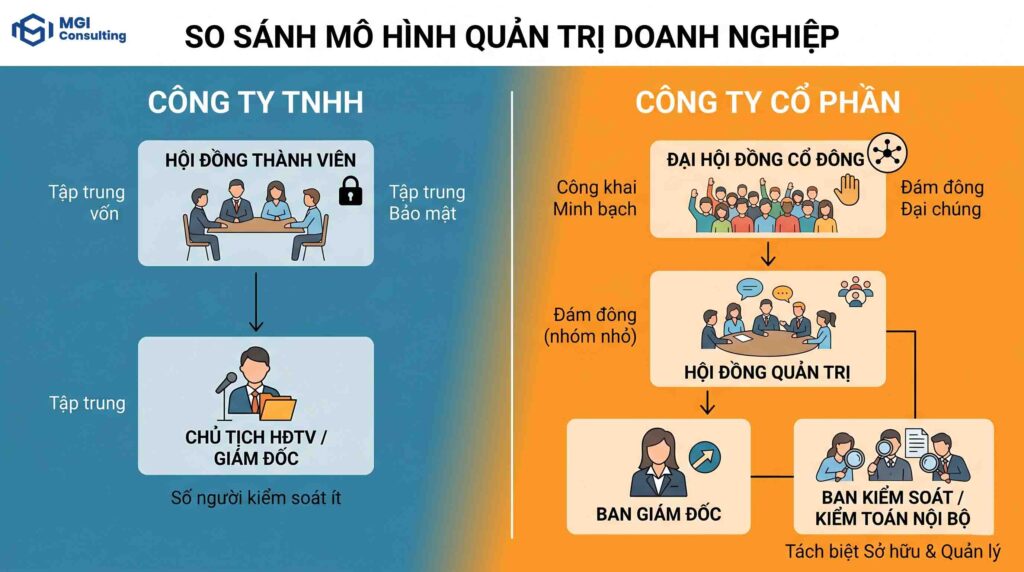
| Governance model | Members’ Council -> Chairman of the Members’ Council -> Director/General Director. | General Meeting of Shareholders -> Board of Directors -> Director/General Director. | Article 54 Article 137 |
| Approval threshold for decisions | Ordinary: >= 65% of the attending capital. Material: >= 75% of the attending capital. | Ordinary: >= 50% of the attending votes. Material: >= 65% of the attending votes. | Article 59 Article 148 |
The Fundamental Differences Between These Two Popular Types of Enterprise
Maximum Member Limit and Business Scale Segmentation
LLC: The maximum limit of 50 members (Clause 1, Article 46) is a legal-technical measure that segments the scale and ensures internal control. This mechanism minimizes the risk of fragmenting decision-making power, making it suitable for enterprises with a centralized governance structure.
Joint Stock Company: With the rule of no limit on the maximum number of shareholders (Point b, Clause 1, Article 111), this is a legal institution designed for unlimited scale expansion. This model establishes the foundation for an enterprise to transition into a public company and list on a centralized stock exchange.
Capital Transfer – Internal Control and Liquidity
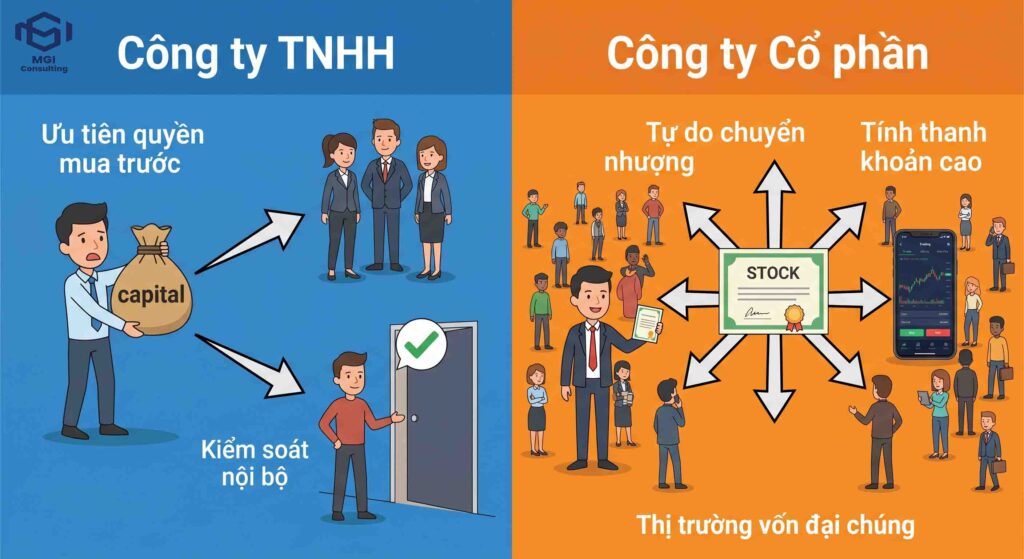
For an LLC: The capital transfer process is strictly controlled by Article 52. When a member intends to transfer their capital contribution, they must offer it to the remaining members in proportion to their respective holdings. Only when the existing members do not buy, or do not buy in full, within 30 days from the date of offer, may that member transfer to a non-member. This provision protects internal confidentiality and consensus.
For a Joint Stock Company: The freedom to transfer shares is the supreme principle recognized in Clause 1, Article 127. The restriction on this right is temporary: Within 03 years from the date of issuance of the Enterprise Registration Certificate, founding shareholders may only transfer ordinary shares to outsiders with the approval of the General Meeting of Shareholders (Clause 3, Article 119). After this period, all legal barriers to the transfer of ownership cease, maximizing the liquidity of the asset.
Finance and the Capital Market
LLC: The restriction of not being allowed to issue shares (Clause 4, Article 46) means the enterprise is deprived of the derivative financial instrument for raising public capital. Additional capital flows can only be structured through increasing members’ capital contributions or accessing the debt credit market.
Joint Stock Company: It holds the privilege of issuing various types of securities (Clause 3, Article 111). This is the core legal basis for carrying out complex financial operations such as: issuing preference shares (dividend, redeemable, voting), share options, or share swaps in mergers and acquisitions.
Frequently Asked Questions (FAQ)
Question 1: My two friends and I (three people in total) plan to contribute capital to open a store. Which type of company should we choose for simplicity?
Answer:
Legal basis: Clause 1, Article 46, and Article 202 of the Law on Enterprises 2020 (amended and supplemented in 2025)
If the initial scale is small and the members all know and trust each other, you should choose a multiple-member LLC (two or more members). This model keeps the internal structure closed and safe, and the procedures for meetings and paperwork management are much simpler than those of a joint stock company. Later, when the store grows and you want to raise substantial capital, you can still carry out procedures to convert into a joint stock company.
Question 2: If the company operates at a loss or goes bankrupt, will my personal house or car be seized to pay the debts?
Answer: No.
Legal basis: Point dd, Clause 1, Article 46, and Point c, Clause 1, Article 111 of the Law on Enterprises 2020 (amended and supplemented in 2025)
Whether you choose an LLC or a joint stock company, both operate under a “limited liability” regime. This means you are liable only for the amount you have contributed or committed to contribute to the company. Personal assets are completely independent of company assets, so you will not have to use your own house or car to repay debts on behalf of the company.
Question 3: If I want my company to be able to list on the stock exchange so that anyone can buy its shares, which model must I choose?
Answer: You must choose a joint stock company.
Legal basis: Clause 4, Article 46, and Clause 3, Article 111 of the Law on Enterprises 2020 (amended and supplemented in 2025)
The law provides that only a joint stock company has the right to issue shares and list on the stock exchange. An LLC is strictly prohibited from issuing shares and therefore cannot achieve this goal.
Question 4: In a joint stock company, can a shareholder freely sell their shares to a stranger outside the company without asking my opinion?
Answer: Yes, entirely.
Legal basis: Clause 1, Article 127, Law on Enterprises 2020 (amended and supplemented in 2025)
This is a defining feature of a joint stock company. Whoever holds shares has the freedom to sell them to anyone they wish without asking permission from the other shareholders (except for a few minor restrictions on founding shareholders during the first 3 years). If you want tight control and do not want strangers entering the company, you should choose the LLC model.
Question 5: If I hold 51% of the capital in the company, do I have full authority to decide everything, including closing the company down?
Answer: No
Legal basis: Clause 2, Article 148, and Clause 3, Article 59 of the Law on Enterprises 2020 (amended and supplemented in 2025)
With 51% of the capital, you can only decide on ordinary day-to-day business matters. For especially important matters such as dissolving the company, changing the business lines, or selling major company assets, the law requires a higher approval threshold (65% or more for a joint stock company and 75% or more for an LLC). Therefore, 51% is not enough for you to unilaterally decide to close the company down.