
From July 1, 2025, a range of new investment regulations officially took effect, creating a mandatory requirement for enterprises to update their project information to ensure legal compliance and transparency. Any change to capital, scale, location, or project schedule must be adjusted promptly to avoid legal risk and protect investment interests.
In this article, MGI Consulting provides a detailed analysis of the process, legal basis, and practical notes for carrying out the procedure to adjust the Investment Registration Certificate under current regulations.
Legal basis, concept, and role of the Investment Registration Certificate
To comply correctly with the regulations, investors must first understand the legal nature of the IRC within Vietnam’s current legal system.
What is the Investment Registration Certificate (IRC)?
The Investment Registration Certificate (IRC) is a document, in either paper or electronic form, issued by the investment registration authority to record the basic information of an investment project, including the investor’s name, objectives, scale, investment capital, location, duration, implementation schedule, and investment incentives.
This document establishes the legal status of the investment project, as stipulated in Article 40 of the 2020 Law on Investment and carried forward, amended, and supplemented in the 2025 Law on Investment.
What is an adjustment to the Investment Registration Certificate?
Adjusting the Investment Registration Certificate is the legal procedure an investor carries out when there is a change to the content of an investment project compared to the information previously licensed by the competent authority.
In other words, this is the process of updating, amending, and supplementing information on the Investment Registration Certificate to accurately reflect actual changes to the project, ensuring that investment activities comply with the law. Under Article 41 of the 2020 Law on Investment, whenever an investor changes the content of an investment project, the investor is obligated to carry out the adjustment procedure with the investment registration authority.
Note: If the adjustment changes the content of the in-principle investment approval, the investor must obtain approval for the adjusted investment policy before proceeding to adjust the Investment Registration Certificate.
Role of the Investment Registration Certificate
The Investment Registration Certificate serves as the foundational legal document expressing the binding commitment between the investor and the State of Vietnam. Specifically:
- It is the basis for carrying out subsequent procedures related to land, construction, tax, and enterprise registration.
- It is a tool for state authorities to monitor and supervise the project’s progress, land-use efficiency, and legal compliance.
- It is the legal basis for the investor to enjoy investment incentives, exercise the right to remit profits abroad, or carry out procedures to adjust the project when changes occur.
- It ensures transparency and legality for all investment and business activities in Vietnam.
Legal basis for adjusting the Investment Registration Certificate in 2025
The issuance, adjustment, and management of the Investment Registration Certificate are carried out based on the following legal framework:
- The 2020 Law on Investment (Consolidated Document No. 134/VBHN-VPQH of 2025): Sets out general provisions on investment and business activities in Vietnam and outward investment from Vietnam.
- The 2020 Law on Enterprises: Provides regulations on the establishment, organizational management, reorganization, dissolution, and operation of enterprises.
- Decree 31/2021/ND-CP: Provides detailed guidance on implementing the Law on Investment (as amended and supplemented by Decree 239/2025/ND-CP).
- Circular 03/2021/TT-BKHDT (as amended and supplemented by Circular 25/2023/TT-BKHDT): Provides regulations on templates and reports related to investment activities in Vietnam.
- Decree 122/2021/ND-CP: Provides regulations on administrative penalties in the field of planning and investment.
In the context of the Vietnamese Government issuing policies to support enterprises and promote the private economy under Resolution 68-NQ/TW and Resolution 02/NQ-CP of 2025, many enterprises have proactively expanded their scale, increased capital, or restructured their investment models. As a result, carrying out the procedure to adjust the Investment Registration Certificate is an essential step to update important project changes in accordance with the law.
Reasons an Investment Registration Certificate adjustment is mandatory
Adjusting the Investment Registration Certificate is a mandatory procedure for enterprises whenever there is a change affecting key elements of the investment project, for the following reasons:

- Compliance with the law: Pursuant to Clause 2, Article 41 of the 2020 Law on Investment, any change related to the content of an investment project must go through the adjustment procedure to ensure legality.
- Avoiding disruption to financial transactions: If the information on the Investment Registration Certificate does not match reality, credit institutions will refuse to disburse funds, receive capital contributions, or execute profit remittance orders abroad.
- A prerequisite for business expansion: Enterprises can only increase capital, expand business lines, or scale up production after completing the corresponding adjustment procedure and obtaining approval from the state authority.
- Ensuring transparency: An updated Investment Registration Certificate is the legal basis reflecting the enterprise’s accurate capacity, scale, and investment commitments to partners and authorities.
- Taking advantage of investment incentive policies: Updating the project content appropriately helps enterprises meet the conditions to enjoy corporate income tax incentives, land rental incentives, or policies supporting access to new markets.
Cases requiring mandatory adjustment of the Investment Registration Certificate (IRC)
Adjusting the Investment Registration Certificate is mandatory whenever there is a change affecting the legal information recorded for the project. Under Clause 2, Article 41 of the 2020 Law on Investment, the investor is obligated to carry out the procedure to adjust the Investment Registration Certificate if there is a change in the project’s objectives, scale, capital, schedule, or implementation location.
Failure to carry out this procedure in a timely manner may lead to serious legal consequences, such as administrative penalties, suspension of operations, or revocation of investment incentives.
Determining the content recorded on the Investment Registration Certificate
Before determining the adjustment plan, enterprises need to clearly understand the basic content recorded on the Investment Registration Certificate under Article 40 of the 2020 Law on Investment. This content includes:
- Name of the investment project.
- Name of the investor and legal information (tax code, address, nationality).
- Objectives and scale of the project.
- Project implementation location and land-use area.
- Total investment capital and capital structure (investor’s contributed capital and mobilized capital).
- Operating duration and project implementation schedule.
- Investment incentives and applicable conditions (if any).
Whenever any of the above content changes, no matter how minor, enterprises need to review the applicable legal regulations to carry out the adjustment procedure and ensure the legality of the project.
Common cases requiring adjustment of the Investment Registration Certificate
For projects that are not subject to in-principle investment approval (or that have changes that do not reach the threshold requiring an adjustment to the investment policy), the investor carries out the procedure to adjust the Investment Registration Certificate in the following cases:

- Change of identifying information: Change of project name, enterprise name, or investor information (due to merger or renaming).
- Change of project objectives or scale: Adding business lines, increasing production capacity.
- Change of investment capital: Increasing or decreasing contributed capital, changing the loan-to-capital ratio.
- Change of location: Relocating the headquarters or factory, or expanding the land-use area (within the permitted scope).
- Change of schedule: Adjusting capital contribution milestones, construction time, or the official operation start date.
- Project transfer: Transferring the entire investment project or part of it to another investor.
- Change of incentives: Adjusting content related to investment incentives under new regulations.
Note: Enterprises should keep the records of Investment Registration Certificate adjustments together with tax, labor, and environmental records to ensure consistency when authorities conduct periodic inspections.
Cases requiring approval of an adjusted in-principle investment approval before adjusting the IRC
This is the most complex group of cases. If the original project was granted an in-principle investment approval decision by a competent state authority (the National Assembly, the Prime Minister, or a provincial People’s Committee), the investor must first obtain approval for the adjusted investment policy before submitting the IRC adjustment application.
Pursuant to Clause 3, Article 41 of the 2020 Law on Investment, enterprises must follow this process when the adjustment content falls into the following cases:
- Changing objectives already stipulated in the in-principle investment approval document; adding objectives subject to in-principle investment approval.
- Changing the project’s implementation location.
- Changing the land-use area by more than 10% or by more than 30 hectares.
- Increasing or decreasing total investment capital by 20% or more, thereby changing the project’s scale.
- Extending the project implementation schedule such that the total investment time exceeds 12 months compared to the schedule stated in the initial in-principle investment approval document.
- Adjusting the project’s operating duration.
- Changing the technology that was appraised and consulted on during the in-principle investment approval process.
- Changing the investor approved under the in-principle investment approval before completing the procedure to obtain the Investment Registration Certificate, or before the project comes into operation (for cases where the in-principle investment approval and investor approval are granted simultaneously).
Clearly distinguishing between the standard IRC adjustment process and the investment policy adjustment process is a key factor that helps enterprises save time and avoid having their application returned due to procedural errors.
If your enterprise is in the process of scaling up or making an important change to its business plan, contact MGI Consulting to have experts assess the legal conditions and support you in preparing an accurate application from the outset.
Conditions for carrying out the procedure to adjust the Investment Certificate
An enterprise may only carry out the procedure to adjust the Investment Registration Certificate when it satisfies all of the following prerequisite conditions:
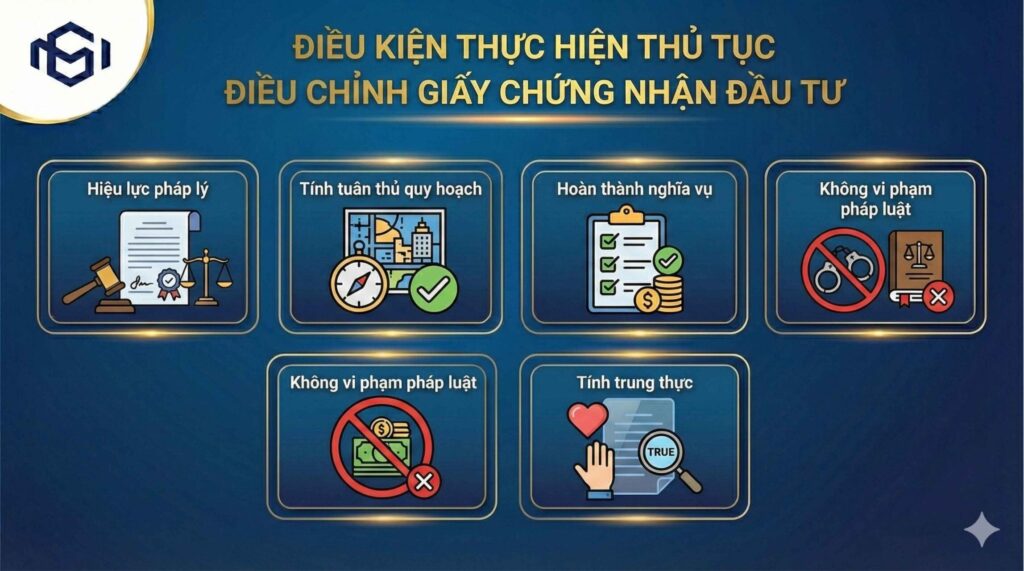
- Legal validity: The Investment Registration Certificate remains valid, and the project is not subject to revocation or currently undergoing termination procedures (Clause 2, Article 41 of the 2020 Law on Investment).
- Compliance with planning: The adjustment content must be consistent with local planning and specialized law (Article 36 of Decree 31/2021/ND-CP, as amended by Article 239 of Decree 239/2025/ND-CP).
- Completion of obligations: The investor has completed its capital contribution obligations on schedule, fulfilled its financial obligations, and complied fully with the periodic investment reporting regime on the National Investment Information System (Article 44 of Decree 31/2021/ND-CP).
- No legal violations: The enterprise has not violated regulations on conducting business in the relevant industry. If a violation has occurred, the enterprise must complete the administrative penalty decision before submitting the adjustment application.
- Accuracy and honesty: The adjustment application has a lawful basis, and the declared information is transparent, accurate, and honest.
Note: Before submitting the application, enterprises should check whether the change in content is subject to the requirement to obtain approval for an adjusted investment policy (under Clause 3, Article 41 of the 2020 Law on Investment) to avoid having the application returned due to a procedural error.
Application dossier for adjusting the Investment Registration Certificate (IRC)
The application dossier requesting an IRC adjustment must be prepared consistently, completely, and with a clear legal basis.
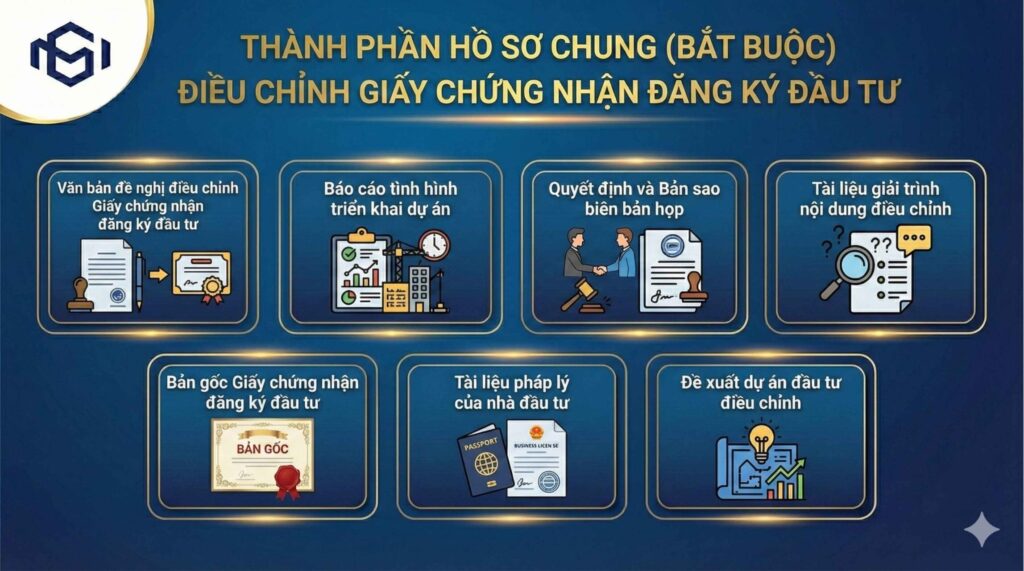
Common dossier components (mandatory)
This group of documents is required for every adjustment case:
- Application form requesting adjustment of the Investment Registration Certificate: Using Form A.I.16 issued together with Circular 03/2021/TT-BKHDT (as amended and supplemented by Circular 25/2023/TT-BKHDT).
- Report on project implementation status: A detailed report on the project’s operational status up to the time of the adjustment request (capital, revenue, labor, tax obligations).
- Resolution and copy of the meeting minutes of the investor regarding the project adjustment (for investors that are organizations).
- Explanatory document on the adjustment content: Clearly stating the reason for and scope of the change (objectives, capital, location, schedule).
- Original Investment Registration Certificate currently in effect (for the state authority to revoke and reissue an updated one).
- Legal documents of the investor: Copy of the citizen ID/passport (for individuals) or the Enterprise Registration Certificate (for organizations).
- Adjusted investment project proposal: Applicable when adding objectives or changing scale or capital (including content on the investor, location, schedule, labor, and socio-economic efficiency).
Supplementary documents corresponding to the adjustment content
Depending on the specific content being changed, enterprises need to prepare the following additional legal documents:
| Adjustment content | Required supplementary documents |
| Change of project implementation location | • Lease agreement for the location/factory. • Copy of documents proving the lessor’s right to lease (land use right certificate, construction permit, or business registration certificate authorizing real estate activities). |
| Change of investment capital | • Bank confirmation of the balance in the investment capital account. • Audited financial statements for the most recent 2 years. • If increasing capital: documents proving the source of the additional capital (financial commitment, balance confirmation, capital contribution agreement). |
| Change of the legal representative | • Copy of the passport/citizen ID of the new representative. • Residence confirmation or temporary residence card (if the new representative is a foreigner). |
| Change of investor information | • Copy of the new legal document reflecting the change (new business registration certificate, new passport). • Documents proving the change of name, address, or merger of the enterprise. |
| Addition of business lines/technology | Explanatory report on the technology used: technology name, origin, process, technical specifications, equipment condition, and technology features under the Law on Technology Transfer. |
| Project under a BCC contract | Business Cooperation Contract (BCC) signed between the parties (amending appendix). |
Dossier preparation and presentation format
During the adjustment process, in addition to preparing sufficient documents, enterprises should pay particular attention to the presentation format to demonstrate professionalism and help the managing authority appraise the dossier quickly:
- Language: The dossier must be prepared in Vietnamese or bilingual Vietnamese-English (foreign-language documents must be consular legalized and notarized in translation).
- Format: Bind the entire dossier into a single volume with a hardcover, ensuring it is secure. Do not use ring binders or leave pages loose, as this makes storage and appraisal difficult.
- Table of contents: Include a full list of documents on the first page and arrange the dossier in the correct legal order.
- Cover information: Clearly state the enterprise/project name; type of dossier (Investment Registration Certificate adjustment); and the submitter’s information (full name, phone number, email).
- Legal validity: The dossier must be fully signed and stamped by the legal representative (or a lawfully authorized person).
Receiving authority: Pursuant to Article 39 of the 2020 Law on Investment, jurisdiction is allocated as follows:
- Management boards of industrial parks, export processing zones, hi-tech zones, and economic zones: Receive applications for investment projects implemented within these zones.
- The Department of Finance: Receives applications for projects implemented outside industrial parks, export processing zones, hi-tech zones, and economic zones, or projects implemented across multiple provinces and cities.
Processing time: Under Article 47 of Decree 31/2021/ND-CP (as amended by Article 239 of Decree 239/2025/ND-CP), the processing time for a valid dossier is as follows:
- 3 working days: For cases involving only a change of the project name or investor name.
- 10 working days: For cases involving adjustment of other content.
Sequence and procedure for adjusting the Investment Registration Certificate (2025 update)
Depending on the content to be changed and the nature of the project, the process for adjusting the Investment Registration Certificate (IRC) will vary considerably. Below is a detailed guide to the 3 standard processes under current regulations:
Process for projects NOT subject to in-principle investment approval

This process applies to common change cases such as: changing the project name or investor name, changing the location (in accordance with planning), increasing/decreasing internal capital, or changing other administrative information that does not involve admitting a new foreign investor.
Step 1: Update enterprise information (if necessary)
If the adjustment content relates to information on the Enterprise Registration Certificate (such as the enterprise name, legal representative, or head office address), the enterprise must first carry out the procedure to change its enterprise registration at the Business Registration Office.
Step 2: Submit the IRC adjustment application
- The enterprise prepares the dossier according to the guidance in Section 3 and submits it to the investment registration authority.
- Submission method: submitted directly at the one-stop-shop department or online through the National Foreign Investment Information Portal.
Step 3: Dossier appraisal
The investment registration authority checks the validity of the dossier. If the dossier is incomplete or needs clarification, the authority will issue a notice requesting amendments or supplements.
Step 4: Issuance of the adjusted Investment Registration Certificate
- Processing time: 10 working days from the date of receiving a complete and valid dossier.
- Special case: If only the project name or investor name is changed, the processing time is 3 working days.

When an enterprise receives additional capital from a new foreign investor or transfers capital to a foreign partner, the process will include more steps to ensure compliance with national security and defense regulations and market access conditions.
Step 1: Register the capital contribution, share purchase, or purchase of contributed capital
The foreign investor submits an application at the Department of Finance where the enterprise’s head office is located to obtain an approval document confirming that the conditions for capital contribution or share purchase are satisfied.
Step 2: Change the members/shareholders on the Enterprise Registration Certificate
After obtaining the approval document, the enterprise carries out the procedure to change its members or shareholders at the Business Registration Office to record the legal status of the new investor.
Step 3: Adjust the Investment Registration Certificate
After completing the enterprise change, the investor submits an IRC adjustment application to update the new investor’s information in the investment project.
Step 4: Obtain a business license (for conditional business lines)
If the new investor is entering a business line that requires a specialized business license (such as retail distribution, education, or healthcare), the enterprise must obtain or adjust the corresponding business license.
Process for projects SUBJECT to in-principle investment approval

This process applies to projects with major changes to objectives or location, a capital increase of over 20% that changes the project’s scale, or an extension of the schedule beyond 12 months (falling within the approval authority of the provincial People’s Committee or the Prime Minister).
Step 1: Apply for approval of the adjusted investment policy
The investor submits the application at the investment registration authority. This authority will collect appraisal opinions from relevant departments and submit the case to the provincial People’s Committee or the Prime Minister for approval.
Step 2: Receive the decision approving the adjustment
After the appraisal process, the competent state authority will issue a decision approving the adjusted investment policy.
Step 3: Reissuance of the Investment Registration Certificate
Based on the decision approving the adjusted investment policy, the investment registration authority will issue the adjusted Investment Registration Certificate to the enterprise within 5 working days.
Important notes and legal risks when adjusting the Investment Registration Certificate
Adjusting the Investment Registration Certificate (IRC) is not merely an administrative procedure — it directly affects the legality of the project and the investor’s rights and interests. Below are 5 key issues enterprises should understand clearly before preparing the dossier, to avoid mistakes and legal risk.

Complying with the sequence between Enterprise Registration and Investment Registration
This is the most common mistake leading to a returned dossier. Enterprises should determine the correct sequence as follows:
Update the Enterprise Registration Certificate (ERC) first: If the adjustment content relates to the legal information of the economic organization (such as the enterprise name, legal representative, or head office address that differs from the project location), the enterprise must first complete the ERC change procedure at the Business Registration Office. Only after the enterprise information has been updated should the enterprise submit the IRC adjustment application, to ensure data consistency.
Separating the certificate for older projects: For enterprises granted an investment license before July 1, 2015 (a combined license covering both business registration and investment registration content), the enterprise must carry out the procedure to split it into a separate Enterprise Registration Certificate and Investment Registration Certificate before making any adjustment.
Cases requiring mandatory approval of an adjusted in-principle investment approval
Investors should note that not every change can be adjusted directly on the IRC. Pursuant to Clause 3, Article 41 of the 2020 Law on Investment, an enterprise must obtain approval for the adjusted investment policy before adjusting the IRC if the change falls into the following cases:
- Increasing total investment capital by 20% or more, thereby changing the project’s scale.
- Expanding the land-use area by 10% or more, or by more than 30 hectares.
- Changing the project’s implementation location.
- Extending the project’s implementation schedule by more than 12 months compared to the original schedule.
- Adding project objectives in an industry or business line that is conditional or has restricted market access for foreign investors.
Enterprises should consult the investment registration authority to determine the correct process, to avoid submitting an IRC adjustment application only to be required to switch to the investment policy adjustment process, which wastes time.
Financial, corporate seal, and business-line obligations after adjustment
In addition to receiving the new certificate, enterprises need to carry out the following tasks to complete the legal process:
Contributing capital in accordance with regulations: For cases involving a new foreign investor or a capital increase, the capital contribution must be transferred into the enterprise’s Direct Investment Capital Account (DICA). Transferring funds into a regular payment account will not be recognized as a valid capital contribution.
Declaring business license tax: If the increase in charter capital changes the business license tax bracket, the enterprise must submit a supplementary business license tax declaration and pay the difference as required.
Re-engraving the seal and public announcement: In the case of an enterprise name change, the enterprise must re-engrave its corporate seal and publish the new seal sample on the National Business Registration Portal.
Sub-licenses: When adding a conditional business line (such as education, healthcare, tourism, or retail), the enterprise must satisfy the conditions on legal capital and professional certificates, and obtain the corresponding business eligibility license.
Submission methods and actual processing time
Enterprises may choose one of two submission methods:
- Online submission: Through the National Foreign Investment Information Portal at fdi.gov.vn (using a digital signature). This is the recommended method to reduce administrative procedures.
- In-person submission: At the one-stop-shop department of the Department of Finance or the management board of the industrial park or economic zone.
Regarding processing time, although the law stipulates 5-10 working days, in practice it may take longer due to reasons such as: the dossier requiring clarification, a foreign-language dossier with an inaccurate translation, or the need to seek appraisal opinions from specialized departments (for content related to planning, the environment, or technology).
Administrative penalties
Delaying or failing to carry out the procedure to adjust the Investment Registration Certificate when a change occurs is a violation of the law. Pursuant to Decree 122/2022/ND-CP (regulating administrative penalties in the field of planning and investment), the penalty levels are as follows:
- Monetary fine: From VND 70,000,000 to VND 100,000,000 for failing to carry out the procedure to adjust the investment project.
- Remedial measures: Forcing the enterprise to carry out the project adjustment procedure. In the case of a serious violation or failure to remedy it, the competent state authority may consider suspending operations or revoking the Investment Registration Certificate.
Frequently asked questions (FAQ) about adjusting the Investment Registration Certificate
Below, MGI Consulting has compiled answers to the most common questions enterprises have during the process of adjusting the Investment Registration Certificate (IRC) under current regulations.
1. What content does the Investment Registration Certificate include?
Under Article 40 of the 2020 Law on Investment, the Investment Registration Certificate records basic information for identifying and managing the project, including:
- Name of the investment project.
- Information about the investor (individual or organization).
- Investment project code.
- Project implementation location and land-use area.
- Objectives and scale of the project.
- Investment capital of the project (including the investor’s contributed capital and mobilized capital).
- Operating duration of the project.
- Project implementation schedule (capital contribution schedule and operation schedule).
- Investment incentives, support, and applicable conditions (if any).
2. When must an enterprise adjust its Investment Registration Certificate?
An enterprise must carry out the adjustment procedure whenever there is a change to any of the content recorded on the Investment Registration Certificate mentioned above. Specifically: a change in the project name, investor information, location, objectives, scale, capital, or implementation schedule. This is a mandatory requirement to ensure the legal information always remains consistent with the project’s actual operations.
3. Does changing the location or name of a project require adjusting the certificate?
Yes. The project name and implementation location are important pieces of information recorded on the Investment Registration Certificate.
- For the project name: When it changes, the investor must carry out the adjustment procedure to ensure legality.
- For the location: Under Article 41 of the 2020 Law on Investment, when relocating or changing the land-use area, the investor is required to adjust the Investment Registration Certificate.
4. In which cases must approval for the investment policy be obtained before adjusting the IRC?
Not every case requires submitting an IRC adjustment application right away. An enterprise must first obtain approval for the adjusted investment policy if the change falls into the following cases:
- Increasing total investment capital by 20% or more, thereby changing the project’s scale.
- Expanding the land-use area by 10% or more, or by more than 30 hectares.
- Changing the project’s implementation location.
- Extending the project’s implementation schedule by more than 12 months compared to the original schedule.
- Adding project objectives in a conditional industry or one with restricted market access for foreign investors.
5. What does the dossier for adjusting the Investment Registration Certificate include?
The standard dossier includes:
- An application requesting adjustment of the investment project.
- A report on the project’s implementation status up to the time of adjustment.
- The resolution and copy of the meeting minutes of the investor regarding the adjustment.
- The original Investment Registration Certificate currently in effect.
- Explanatory documents on the adjustment content (financial documents, land documents, the investor’s legal documents, etc.).
6. How long does the procedure take to process?
Under the regulations, the processing time is as follows:
- 3 working days: For cases involving only a change of the project name or investor name.
- 10 working days: For cases involving adjustment of other content. However, in practice, the time may be longer if the dossier requires amendment or supplementation, or if appraisal opinions from relevant specialized authorities are needed.
7. Can the application be submitted online?
Yes. Enterprises can submit the application online through the National Foreign Investment Information Portal (fdi.gov.vn) using an issued account and digital signature. Online submission saves travel time; however, enterprises still need to submit a hard copy of the dossier for the investment registration authority to cross-check before receiving the result.
8. Is there a penalty for failing to make the adjustment as required?
Yes. Under Article 17 of Decree 122/2021/ND-CP, failing to carry out the procedure to adjust the Investment Registration Certificate when there is a change to the project content will result in a fine of VND 70,000,000 to VND 100,000,000. In addition, the enterprise must carry out the remedial measure of completing the investment project adjustment procedure.
9. What should an enterprise do after being granted the adjusted certificate?
After completing the procedure, the enterprise needs to carry out the following tasks to synchronize its legal status:
- Update the project information on the National Investment Information System.
- Notify the Tax Authority, the bank, and relevant partners of the changed information.
- Carry out the procedure to adjust related sub-licenses (Enterprise Registration Certificate, Environmental License, Construction Permit, Work Permit, etc.).
- Continue to comply with the periodic reporting regime on the project’s operational status.
Conclusion
The procedure to adjust the Investment Registration Certificate is a key legal step to ensure the legality and rights of enterprises throughout their operations in Vietnam. In particular, with the new regulations effective from July 1, 2025, complying correctly with the process, dossier requirements, and deadlines not only helps enterprises avoid the risk of administrative penalties (of up to VND 100 million) but is also a prerequisite for accessing the Government’s new investment incentive policies.
Investors should proactively review the legal status of their projects on a periodic basis. If there is any change in scale, capital, location, investor information, or implementation schedule, the enterprise should carry out the adjustment procedure immediately to maintain stable and transparent business operations.
Don’t let complicated administrative procedures slow down your business plans. Contact MGI Consulting today for fast, fully compliant, end-to-end support in adjusting your Investment Certificate under the 2025 regulations.
Details of MGI Consulting’s service: Investment Registration Certificate (IRC) adjustment service