
Company formation is the legal process by which the state recognizes an organization as a legal entity, allowing it to trade lawfully and issue invoices.
The core, up-to-date conditions for setting up a company include: a founder with full civil-act capacity, a company name that is not duplicated, a clearly defined head office, and a charter capital level appropriate to the business line.
In the digital era of 2026, submitting an application for a business licence can take just a few minutes through the government’s online portal. Yet behind that convenience lie extremely rigorous tax audits and capital-flow inspections.
What is company formation?
Company formation is the legal procedure through which the state recognises the birth of a business organisation with legal-entity status. It helps you separate personal assets from market risks, legitimise invoicing, and raise capital.
Many people mistakenly believe business registration is merely a mandatory formality so the state can collect taxes. In reality, the core value it delivers is far greater.

In essence, forming a company means creating an independent legal entity with assets, rights, and obligations entirely separate from the individual founder. This separation lets business owners ring-fence commercial risk, limiting debt liability to the amount of capital contributed. As a result, your personal assets and your family’s peace of mind remain fully protected.
Think of starting a company as equipping yourself with a solid risk shield, not taking on extra administrative burdens.
3 core privileges when your business holds legal-entity status
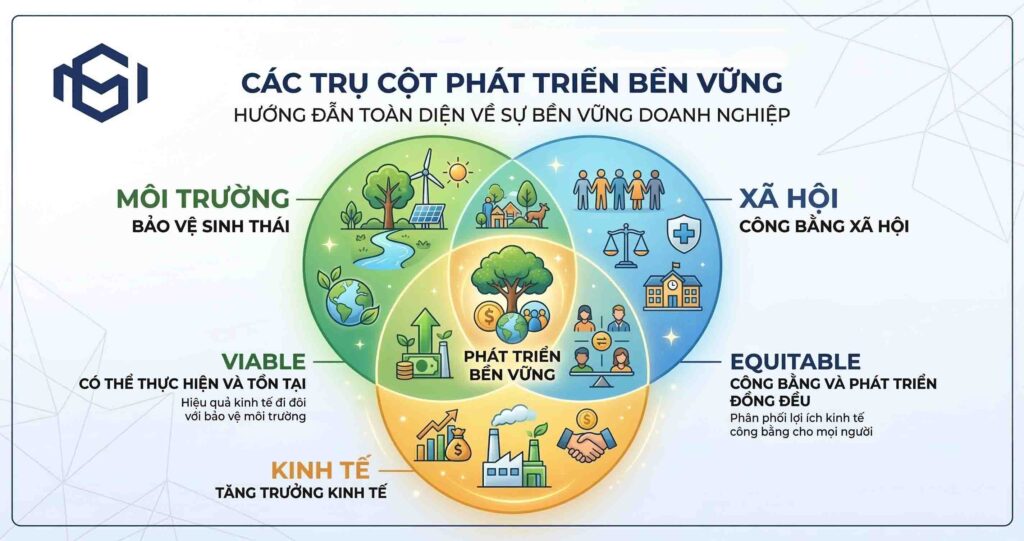
Officially holding legal-entity status grants you 3 major privileges:
- Legitimacy in the marketplace: You have full standing to issue value-added tax (VAT) invoices, letting you confidently approach large corporate partners and sign high-value contracts.
- Activating the limited-liability shield: If your business hits trouble, you are only liable up to the capital you committed to contribute. Personal assets you have built up, such as your home and vehicles, remain entirely untouchable.
- Creating powerful financial leverage: A legal entity is a prerequisite for issuing shares, raising capital from angel investment funds, or accessing corporate loans from banks.
Basic conditions to establish a business – Updated under the 2026 Law on Enterprises
Under current regulations, to establish a company lawfully you must meet 4 core conditions: the founder has full civil-act capacity, the business name is not duplicated, the head office has a clear address, and the charter capital is appropriate to the business line.
Although the company-formation process has been considerably relaxed, post-registration inspection is stricter than ever. Below is a roadmap to help you clear these 4 checkpoints safely and lawfully.

Group 1: Who is entitled to register a company?
Every individual aged 18 or older with full civil-act capacity is entitled to form a company, except for certain groups restricted by law to ensure transparency in state management and social order.
Entrepreneurial opportunities are always open to the vast majority of people. As long as you meet the basic standards of civil-act capacity, you can fully begin building your own business empire. However, before submitting your application, you should carefully check whether you fall into the restricted list below.
Exceptional cases banned from forming a company (Note this immediately)
State cadres, civil servants, and public employees, as well as those serving a prison sentence or banned from practising, are not permitted to stand as business managers. However, this group still has the right to contribute investment capital, provided they do not violate the Anti-Corruption Law.

This is a legal barrier that troubles many people, especially state cadres and public employees. The law stipulates that this group, along with those serving a prison sentence or banned by a court from practising, are absolutely prohibited from standing as founders or holding any management position in a company. The purpose of this rule is to prevent conflicts of interest and ensure fairness and transparency in the market.
A safe solution for you: If you work in the state sector but still cherish a promising business project, don’t give up too soon. The law does not completely block your path. The lawful way out is that you are fully entitled to contribute capital or buy shares in limited liability companies or joint-stock companies. This way, you can legitimately accompany the project as an investor without breaching the rules that ban business management.
Group 2: Identity conditions – How should the name and head office be to avoid rejection?
Identity conditions require that the company name must not be identical to, or confusingly similar to, businesses already registered nationwide. The head office must be a lawful contact location with a clear house number, and must absolutely not be located in an apartment intended purely for residential use.
Applications being returned repeatedly by the authorities often stem from errors in business identification. To ensure your application is approved on the very first submission, you need to master the rules for naming your business and choosing its location.
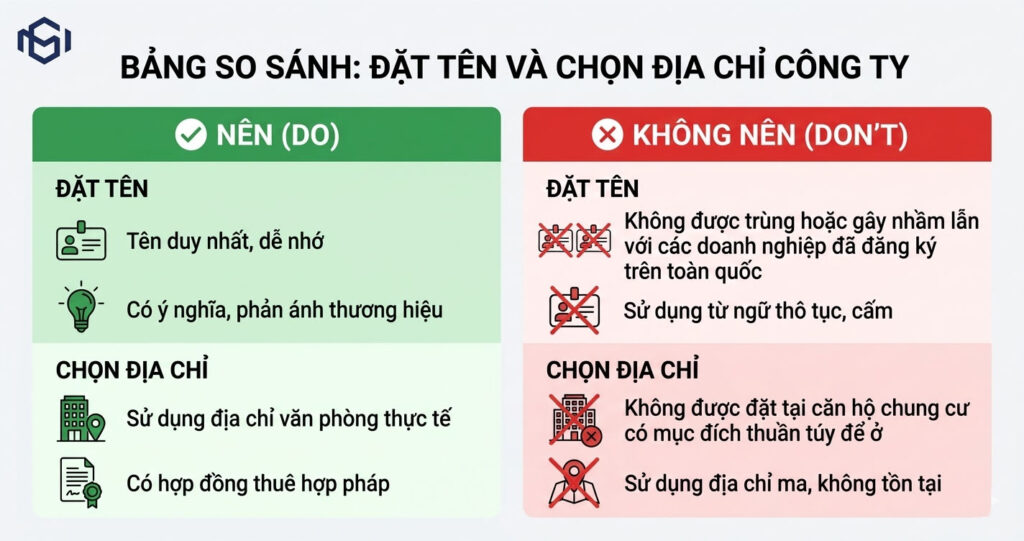
Regarding the name, a standard structure must include the business type combined with a proper name. To avoid legal risk, your proper name must absolutely not be identical to, or confusingly similar to, any brand already existing on the national business database.
The next headache for many founders is business premises. By law, the head office must be a real location. Note in particular that you must absolutely not use a residential family apartment as your business registration address. This is a common mistake that causes many startup applications to be flatly rejected by the managing authority.
A budget-friendly solution for you: If you are a tech startup, a freelancer, or simply want to cut expensive premises-rental costs to a minimum in the early stage, a virtual office service is the ideal solution. For just a small monthly fee, you immediately gain a fully lawful business registration address in professional office buildings.
This solution not only eases the financial burden but also helps your business build a reputable, trustworthy image in the eyes of large partners.
Group 3: Charter capital and business lines
For most ordinary business lines, the law does not set a minimum charter capital, allowing enterprises to self-declare. However, for conditional business sectors such as healthcare, real estate, or security services, you are required to meet the legal capital level under specialised law.
To picture and review this easily, you only need to clearly distinguish two concepts: unconditional business lines and conditional business lines.
If you run ordinary trade or services, you have full authority to decide the capital contributed to your company. But if you step into fields with far-reaching social impact such as education, healthcare, or real estate, the state will require you to prove your financial capacity through a minimum legal capital. Confusing self-declared capital with mandatory legal capital is exactly what causes many launch plans to be postponed indefinitely.
The truth about charter capital: How much is safe to register without losing your assets?
Charter capital is the limit of the business owner’s asset liability. Inflating the capital figure to create a facade of credibility is a fatal mistake, because when litigation arises, the founder must be liable with their own personal assets for the committed but under-contributed capital.
The common mindset of many new entrepreneurs is to record a truly impressive figure (for example, 10 billion VND) to make the application look striking and to flaunt scale to partners. This is an extremely dangerous psychological trap. You need to clearly understand the principle: the declared figure may be fake, but the legal liability is real.

When risk strikes or the business is forced to declare bankruptcy, the authorities will not care how much money you actually paid into the company account. They will base their compensation demand solely on the figure you committed to on the licence.
If you record 10 billion but actually have only 1 billion, you face the risk of liquidating your home and personal vehicles to cover the remaining 9 billion to meet your debt obligations. In addition, the higher the registered charter capital, the higher the annual business licence tax you must pay, inadvertently creating an unnecessary financial burden for a young business.
So how much is safe to register? Based on real business-consulting experience — the kind the law never writes down — MGI offers you a formula to optimise your capital flow:
Safe charter capital = Initial investment cost + Operating maintenance cost for 6 consecutive months.
Mastering the foundational conditions above is only the initial review step. To bring an organisation into lawful operation and optimise all tax obligations, business owners need a complete legal-structure blueprint. Experimenting with the process or guessing at current regulations often leads to heavy administrative penalties during the post-inspection stage.
Frequently Asked Questions (FAQ)
Q1. To form a company, do I need permanent residence registration at the head-office location?
Absolutely not. You can have your household registration in Ca Mau yet still be entitled to form a company and locate its head office in Ho Chi Minh City or Hanoi as normal, as long as that head-office address is lawful and real.
Q2. Can I be an employee at another company and register my own company at the same time?
Yes. The law does not prohibit employees from forming their own company. However, you should review the confidentiality agreement or labour contract with your current employer to check for any non-compete clause, so as to avoid trouble.
Q3. After obtaining a business licence but with no revenue yet, do I still have to pay taxes?
Yes. Even without issuing invoices or earning any revenue, you are still required to pay the annual business licence tax and to file periodic tax returns in order to maintain active status and avoid having your tax code locked.
Instead of spending time on troubleshooting, approach the business-formation steps from a professional risk-management perspective. MGI has systematised the entire process — from application review and capital-flow optimisation to initial accounting operations — into a single body of knowledge.
We invite you to dive deeper in our pillar article: THE COMPLETE GUIDE TO COMPANY FORMATION – LATEST 2026
In this strategic handbook, MGI’s team of legal experts pinpoints every procedural loophole in detail and provides ready-made document templates that meet state-agency standards. You only need to focus on your core competency — growing your business — while MGI takes care of the entire solid legal foundation.