
In business, terminating the operations of an investment project is an important legal event that directly affects the rights and obligations of the investor as well as the related parties (state management agencies, business partners, and employees). To ensure this process is carried out transparently, minimizes risks, and complies with the law, the investor needs to clearly understand the cases of termination and the accompanying administrative procedures.
The article below by MGI Consulting provides a complete legal information framework on the conditions, dossier, and process for terminating an investment project under current regulations.
Overview of investment projects and the rules on terminating operations
Before carrying out the administrative procedures, the investor needs to clearly determine the legal nature of the project and the applicable basis, and understand the concepts and the essence of this activity.
Legal basis
The procedure for terminating an investment project’s operations is currently governed by the following legal documents:
- Law on Investment No. 61/2020/QH14 dated June 17, 2020.
- Government Decree No. 31/2021/ND-CP dated March 26, 2021, detailing and guiding the implementation of a number of articles of the Law on Investment.
- Circular No. 03/2021/TT-BKHDT dated April 9, 2021, of the Ministry of Planning and Investment prescribing the templates of documents and reports related to investment activities in Vietnam, outward investment from Vietnam, and investment promotion.
Definition and classification of investment projects
Pursuant to Clause 4, Article 3 of the Law on Investment 2020, an investment project is a collection of proposals to invest medium- or long-term capital to conduct business investment activities in a specific location over a defined period.
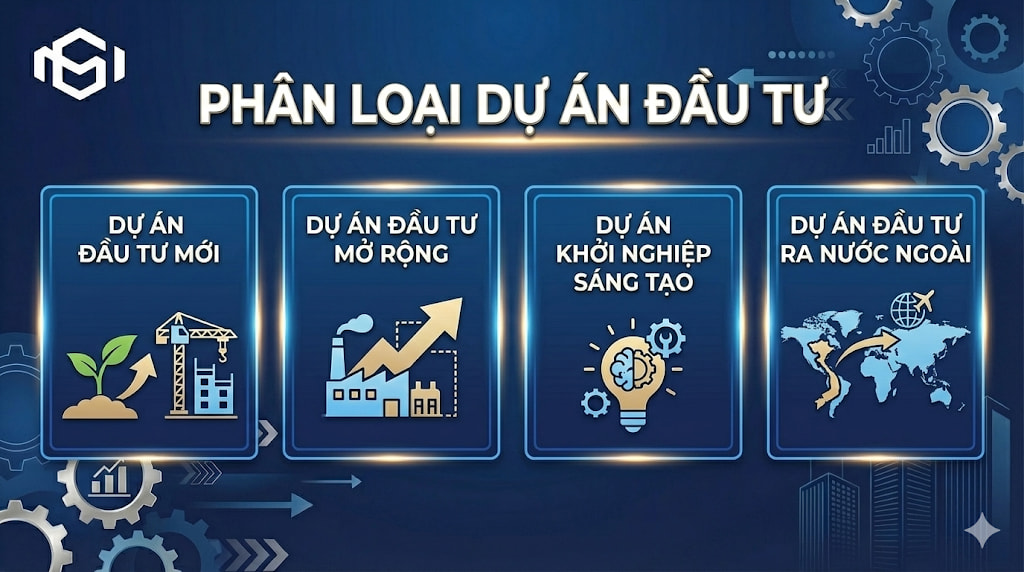
Depending on their nature, scale, and location, investment projects are classified as follows:
- New investment project (Clause 6, Article 3): A project implemented for the first time or a project operating independently of an ongoing one.
- Expansion investment project (Clause 5, Article 3): A development project derived from an operating one to expand scale, increase capacity, innovate technology, reduce pollution, or improve the environment.
- Innovative startup project (Clause 7, Article 3): A project implementing an idea based on exploiting intellectual property, technology, or a new business model, with the potential for rapid growth.
- Outward investment project (Clause 13, Article 3): The investor transferring investment capital from Vietnam abroad; using the profits earned from this capital to conduct business investment activities overseas.
- Eligible entities: Enterprises, cooperatives, credit institutions, business households, individuals with Vietnamese nationality, and other organizations as prescribed by law.
The concept of terminating an investment project’s operations
Terminating an investment project’s operations, also known as stopping an investment project, is when a project ceases implementation and does not continue for various reasons, such as the expiry of the legal validity of the related investment approval documents.
This termination may arise from two cases:
- Voluntary: The investor proactively decides to terminate operations.
- Compulsory: The competent state management agency issues a decision to terminate operations when the project violates the law or no longer meets the current conditions.
This is a mandatory procedure for the investor to complete its financial and legal obligations with the State and third parties before dissolving the economic organization or moving to another investment activity.
Cases of terminating an investment project’s operations
Pursuant to Article 48 of the Law on Investment 2020 and Article 41 of Decree 31/2021/ND-CP, the termination of an investment project’s operations is divided into two main groups: voluntary termination (decided by the investor) and compulsory termination (decided by the state authority).
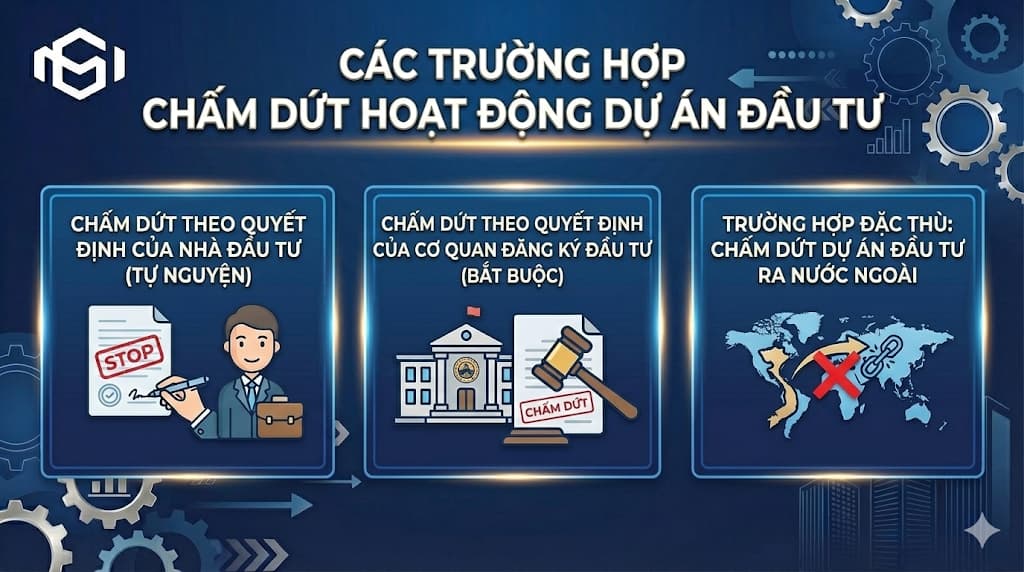
Correctly identifying the termination case will help the investor prepare the liquidation dossier and handle the assets appropriately.
Termination by the investor’s decision (Voluntary)
This is where the investor proactively ends the project based on business needs or previously agreed commitments. It specifically includes 3 cases:
- The investor decides to terminate on its own: The investor has the right to unilaterally decide to stop the project due to a change in strategy, financial difficulties, or the achievement of the business objective.
- Expiry of the operating term: An investment project usually has an operating term (e.g., 50 years, 70 years) stated on the Investment Registration Certificate. When this term expires and the investor does not carry out the extension procedure or is not granted an extension, the project naturally terminates.
- Under contract/charter conditions: The project terminates when events or conditions predefined in the Business Cooperation Contract (BCC) or the charter of the enterprise implementing the project occur.
Termination by the Investment Registration Authority’s decision (Compulsory)
The Investment Registration Authority is competent to issue a decision to terminate all or part of a project if the investor violates the law or is no longer able to implement the project.
The cases of compulsory termination include:
- Failure to remedy a violation after suspension: The project has been required by the state authority to suspend operations (due to environmental, labor safety violations, etc.), but the investor is unable to remedy the suspension conditions.
- Loss of the right to use the investment site: The investor is no longer allowed to use the investment site (e.g.: the landlord reclaims the premises, the land lease expires) and does not carry out the procedure to adjust to a new site within 06 months.
- Project not implemented and out of contact: The project has stopped operating and 12 months have passed since the stoppage, and the Investment Registration Authority cannot contact the investor or its legal representative.
- Land recovery: The project is subject to land recovery by the State for not putting the land into use or for delaying its use as prescribed by the Land Law.
- Sham transactions: The investor conducts investment activities based on sham civil transactions (to conceal other purposes or evade obligations) as prescribed by civil law.
- Violation of the escrow obligation: For projects subject to an implementation guarantee (escrow), if the investor fails to make the escrow or has no guarantee for the escrow obligation as prescribed.
- Under a legal ruling: Termination is carried out under an effective judgment or decision of a Court or the ruling of a commercial Arbitration.
New note (Updated rule on schedule): The Investment Registration Authority also considers terminating a project if, 24 months after the end of the implementation schedule (stated on the Investment Certificate), the investor still has not achieved the objectives and is not in a case eligible for schedule adjustment.
Special case: Terminating an outward investment project
For Vietnamese enterprises investing abroad, the termination of a project is separately regulated in Article 64 of the Law on Investment 2020. In addition to reasons similar to domestic investment (own decision, expiry of the term), an outward investment project is also terminated in the following cases:
- Capital transfer: The investor transfers all of its overseas investment capital to a foreign investor.
- Overdue implementation: More than 24 months have passed since the Outward Investment Registration Certificate was granted, but the investor has not implemented the project and has not adjusted the schedule.
- Dissolution in the host country: The economic organization abroad is dissolved or goes bankrupt under the law of the investment-receiving country.
Legal consequences of terminating a project
When an investment project is terminated (whether voluntary or compulsory), the investor must fulfill the following obligations:
- Liquidate the project: The investor liquidates the project itself in accordance with the law on asset liquidation.
- Handle land use rights: The handling of land use rights and assets attached to the land is carried out under the land law.
- Revoke the license: The Investment Registration Authority will issue a decision to revoke the Investment Registration Certificate (except in the case of partial termination).
Understanding the above cases helps the investor proactively manage the project’s lifecycle and avoid violations leading to compulsory termination that causes economic loss.
Procedure for terminating an investment project’s operations (Latest update)
Correctly carrying out the project termination procedure helps investors and enterprises complete the legal steps when ending operations, ensures compliance with current regulations, avoids the risk of disputes, and enables the Investment Registration Authority to confirm the termination transparently.
Pursuant to Decree 31/2021/ND-CP, the process is divided specifically by each case below:
Case 1: The investor decides to terminate operations on its own
This is where the investor proactively stops the project, the project’s operating term expires, or it terminates under the conditions stipulated in the contract or charter.
Dossier components:
- Decision to terminate the investment project’s operations (or the written termination notice).
- Investment Registration Certificate (original, if any).
- Documents proving the termination of operations (for cases of termination under contract/charter conditions or asset liquidation).
Implementation sequence:
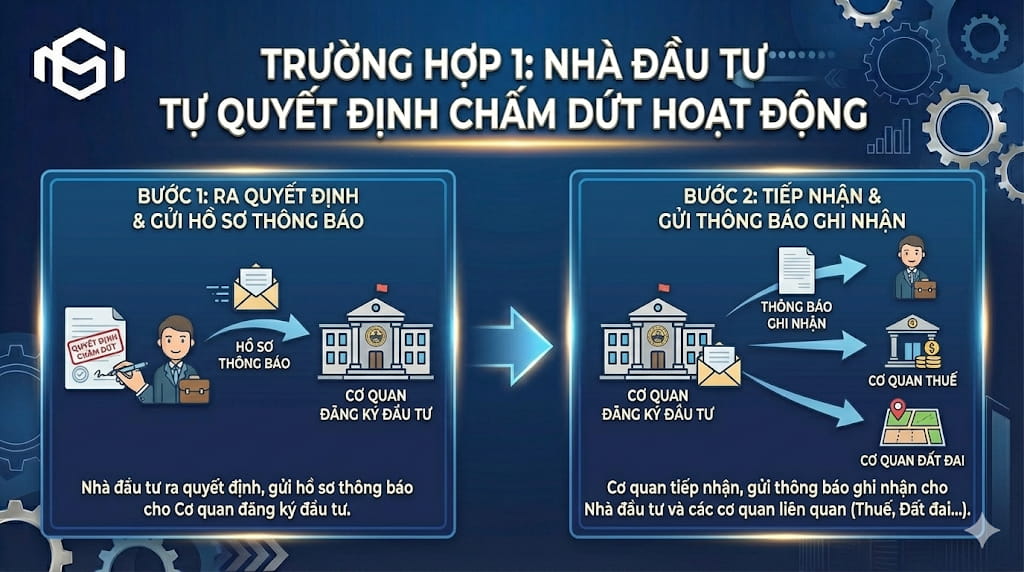
- Step 1: Within 15 days from the date the termination decision is made or the date the project’s operating term expires, the investor sends the notification dossier to the Investment Registration Authority.
- Step 2: The Investment Registration Authority receives the dossier and sends a notice recording the termination of the project’s operations to the investor and the relevant agencies (Tax Authority, Land Agency, etc.).
Case 2: The Investment Registration Authority decides to terminate (Due to violation or compulsory)
Applies to projects under Clause 2, Article 48 of the Law on Investment (e.g., failure to remedy the suspension conditions, legal violations, etc.).
General process:
- Step 1: The Investment Registration Authority prepares minutes recording that the project falls into a case requiring termination of operations.
- Step 2: The Investment Registration Authority issues a Decision to terminate the investment project’s operations and simultaneously revokes the Investment Registration Certificate (if any).
Specific processes for particular cases:
For projects subject to land recovery:
- The Investment Registration Authority prepares minutes recording that the investor has not put the land into use or is behind schedule in using the land.
- The competent state authority issues a decision to recover the land.
- Based on the land recovery decision, the Investment Registration Authority issues a Decision to terminate the investment project’s operations.
For projects that have stopped operating and the investor cannot be contacted:
- Prepare minutes: Recording that the project has stopped operating and the investor cannot be contacted.
- First notice: Send a written request for the investor to make contact, to the registered address.
- Second notice & Posting: If after 30 days the investor does not respond, the Investment Registration Authority sends a written request for search assistance to the commune-level People’s Committee (place of residence) or the diplomatic agency (for foreign investors), and simultaneously posts the notice on the National Investment Portal for 90 days.
- Issue the decision: When the 12-month period from the date of stoppage ends and contact still cannot be made, the Investment Registration Authority issues a Decision to terminate the project’s operations.
- For projects implemented on the basis of a sham civil transaction:
- The Investment Registration Authority relies on the Court’s judgment/decision or the commercial Arbitration’s ruling on the sham transaction.
- Issues a decision to terminate the investment project’s operations.
6. Dossier and process for terminating an outward investment project
For Vietnamese investors with projects abroad who wish to terminate operations, the procedure is carried out under Article 87 of Decree 31/2021/ND-CP.
6.1. Prerequisite: Liquidation and repatriation of capital
Before submitting the termination dossier in Vietnam, the investor must complete the procedures in the host country:
- Liquidate the project under the law of the investment-receiving country.
- Within 06 months from the date of the tax finalization report or an equivalent document on the liquidation, the investor must repatriate all proceeds (money, assets) from the liquidation to Vietnam.
- Note: If an extension of the repatriation deadline is needed, a written request must be sent to the Ministry of Planning and Investment (extension of no more than 06 months).
6.2. Application dossier (01 original set)
- Written request to terminate the validity of the Outward Investment Registration Certificate (using the template in Circular 03/2021/TT-BKHDT).
- Original of the granted Outward Investment Registration Certificate.
- Decision to terminate the investment project abroad.
- Documents proving the completion of the project’s liquidation and the repatriation of money/assets.
- Documents on the investor’s legal status.
6.3. Implementation sequence
- Step 1: The investor submits the dossier to the Ministry of Planning and Investment.
- Step 2: The Ministry of Planning and Investment checks its validity and sends the dossier to consult the State Bank of Vietnam on the investor’s compliance with foreign exchange regulations.
- Step 3: Within 15 days from the date it receives a valid dossier and the State Bank’s opinion, the Ministry of Planning and Investment issues a Decision to terminate the validity of and revoke the Outward Investment Registration Certificate.
- Step 4: The Decision is sent to the investor and the relevant agencies (State Bank, Ministry of Finance, Ministry of Foreign Affairs, Tax Authority, etc.).
7. Obligations to fulfill upon terminating a project
Submitting the termination notification dossier is not the final step. To complete its legal responsibility, the investor is required to fulfill the following obligations:
- Liquidate assets: Sell, transfer, or handle the project’s assets in accordance with the law.
- Settle debts:
- Fully pay all tax and fee debts to the State.
- Pay loans and debts to suppliers and partners.
- Settle employees’ benefits: Pay wages, severance/job-loss allowances, and finalize employees’ social insurance books under the Labor Code.
- Handle land matters: Carry out the procedure to return the land or handle assets attached to the land under the Land Law (for projects that lease land).
- Compensate for damages: If the project’s termination causes damage to related parties (due to breach of contract), the investor is responsible for compensation under the agreement or the law.
Note: For a project operating under an Investment Certificate (which is simultaneously the Business Registration Certificate), the Investment Registration Authority only terminates the project’s operations without revoking this Certificate. The enterprise needs to continue with the business registration authority’s procedures if it wants to dissolve the enterprise.