
Fulfilling your rental property tax obligations in 2026 brings substantial benefits to property owners. With the tax-exemption threshold raised to VND 500 million, individuals leasing rooms or commercial premises will see a significant reduction in financial pressure. This article compiles the complete procedures, required documents, and detailed calculation methods, helping you stay compliant with the law while optimizing your profits with confidence.
The real estate leasing market remains a consistently profitable investment channel. However, at the start of every year, property owners face a wave of questions about legal procedures and financial obligations toward state authorities. Constant changes in the legal framework can inadvertently leave you facing late-payment penalties or unnecessary overpayments.
The detailed guide below acts as your personal tax advisor, resolving every concern you may have — from reviewing the latest regulations to easily filing your tax return online.
Is Rental Income From Leasing a House Subject to Tax?
Many property owners wonder whether leasing a house is subject to tax and whether business registration is required. Under current regulations, individuals leasing property are not required to establish a household business, but they are required to pay tax once total revenue exceeds the VND 500 million threshold.

One of the biggest psychological barriers for people starting to lease out rooms or commercial premises is the fear of getting tangled up in cumbersome licensing procedures. Current law is very clear: for small-scale property leasing that does not involve accommodation-related services (such as daily housekeeping or on-site meal service), individuals are not required to register a household business.
Notably, for rental property tax matters, you can use your personal tax code directly to file your declaration. You only become liable to pay tax to the state once the total revenue from all your lease agreements combined, within a single calendar year, exceeds the prescribed threshold.
New 2026 Rental Property Tax Regulations: The VND 500 Million Threshold and Business License Fee
The new rental property tax regulations set the tax-exemption threshold at VND 500 million per year. Once this threshold is exceeded, property owners are required to pay the business license fee along with VAT and Personal Income Tax (PIT) as prescribed.
The 2026 legal regulations bring a major benefit to landlords. To determine your obligations, you need to total all revenue from leasing real estate (including houses, commercial premises, and factories/warehouses) for the year.
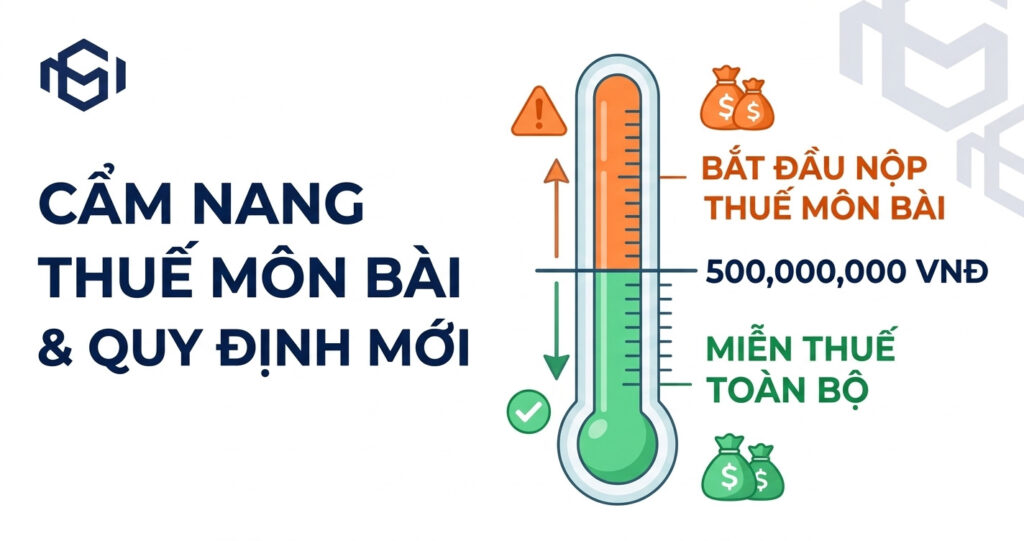
Case 1: Total annual revenue of VND 500 million or less.
You are fully exempt from all taxes and fees. You do not need to file a VAT return or a PIT return, and you are also exempt from filing the business license fee declaration.
Case 2: Total annual revenue above VND 500 million.
In this case, you are required to fulfill 3 financial obligations:
- Business license fee for property leasing: The fee amount is based on your revenue scale. Typically, for revenue above VND 500 million, the business license fee payable to the state treasury is VND 1,000,000/year. If you start leasing in the last 6 months of the year, the fee for that first year is only VND 500,000.
- Value Added Tax (VAT).
- Personal Income Tax (PIT).
Detailed Guide to Calculating Rental Property Tax
The 2026 method for calculating rental property tax follows a fixed-rate-with-deduction formula. VAT is calculated at 5% of total revenue. Personal Income Tax is calculated at 5% of the revenue remaining after deducting VND 500 million.
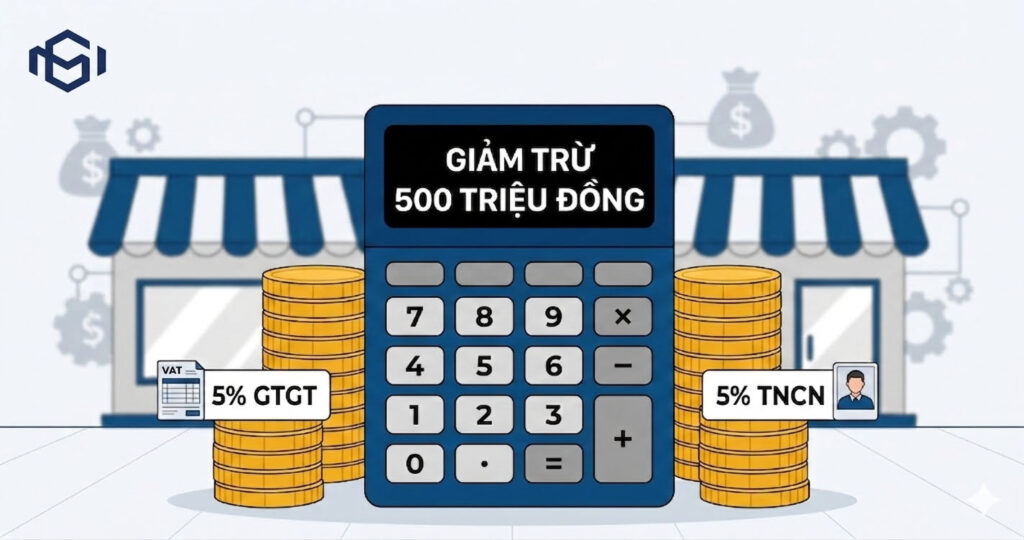
Unlike the complex presumptive tax methods used previously, the method for calculating rental property tax under Circular 18/2026/TT-BTC is clearly defined through fixed percentage rates applied to revenue.
The exact formula:
- VAT payable = Total revenue x 5%.
- PIT payable = (Total revenue – VND 500 million) x 5%.
A practical example to help you visualize this: Ms. A leases commercial premises for VND 80 million/month. Ms. A’s total revenue for 2026 is VND 960 million. The taxes she must pay are calculated as follows:
- Business license fee: VND 1,000,000/year.
- VAT payable: 960,000,000 x 5% = VND 48,000,000.
- PIT payable: (960,000,000 – 500,000,000) x 5% = VND 23,000,000.
- Total amount payable: VND 72,000,000.
Where a property is jointly owned by multiple co-owners, the VND 500 million revenue threshold used for the tax exemption is determined for only the single representative who signs the lease agreement, and is not divided equally among the co-owners.
Complete Rental Property Tax Declaration Dossier Under Circular 18/2026/TT-BTC
The rental property tax declaration dossier includes Return Form 01/TTS, the detailed lease-contract schedule Form 01-1/BK-TTS, along with a copy of the lease agreement and citizen identity card. The dossier must be fully prepared to avoid being rejected by the tax authority.

How carefully you prepare your supporting documents directly determines whether your dossier gets approved quickly. A valid rental property tax declaration dossier must include all of the following components:
- Tax return for property leasing activities: Form 01/TTS issued together with the Circular must be used.
- Detailed lease-contract schedule: Form 01-1/BK-TTS must be used. This schedule details the property address, rental price, area, and contract term.
- A copy of the lease agreement and any addenda (if the rental price or term has been updated).
- A copy of the power of attorney as required by law (applicable only if you authorize another individual to carry out the procedure on your behalf).
The Optimal Solution: Businesses Paying Tax on Behalf of the Landlord
The model in which a business pays tax on behalf of the landlord is the optimal time-saving solution. The company’s accountant will use Form 01/TTS, tick the “Filing on Behalf” box, and attach the lease agreement clearly stating the tax-payment authorization clause as the legal basis.

If your tenant is an organization or a company, you can fully request that the business pay tax on your behalf as the landlord. To do this lawfully, you must keep two key points in mind:
First, the lease agreement must include a clause clearly stating that the tenant is responsible for withholding the tax amount and directly filing and paying the taxes related to this leasing activity on behalf of the landlord.
Second, when carrying out the procedure, the tenant business’s accountant will prepare the return using Form 01/TTS, while also marking an X in the “Business filing on behalf” checkbox on the form. The company may pay tax by payment period or annually, and the tax authority will issue the payment receipt under the landlord’s name to serve as proof that the obligation has been fulfilled.
Deadlines for Filing Rental Property Tax and Where to Submit the Dossier
Deadlines for filing rental property tax are strictly regulated. When filing by payment period, the deadline is the last day of the first month of that payment period. When filing annually, the deadline is January 31 of the following year.
The Law on Tax Administration clearly classifies the filing deadlines so taxpayers can flexibly choose:
- Filing by payment period: Applies when the lease agreement specifies payment every 3 months, 6 months, or once a year. The deadline for submitting the dossier and paying tax is the last day of the first month of that payment period.
- Filing once annually: Applies if you want to combine everything into a single filing. The deadline for submitting the dossier is January 31 of the following calendar year.
Regarding where to submit a paper dossier, you must file it at the Tax Sub-Department directly managing the location where the leased property is situated, not the place where you register your permanent residence.
Steps to File Rental Property Tax Online

The launch of the eTax electronic tax system has enabled property owners to file returns 24/7 without needing to visit a state authority in person. Below is the 4-step process for filing rental property tax online:
- Step 1: Go to the General Department of Taxation’s electronic portal at thuedientu.gdt.gov.vn. Select the Individual section and log in using your VNeID account or personal tax code.
- Step 2: On the toolbar, select the Tax Filing section, then find the Property Leasing Tax Filing tab. The system will display the online return corresponding to Form 01/TTS.
- Step 3: Enter the complete contract and rental price details into Schedule 01-1/BK-TTS on screen. The system will automatically calculate the VAT and PIT amounts you owe. Attach a scanned copy of the lease agreement in PDF format.
- Step 4: Review the information, enter the OTP verification code sent to your phone number, and click Submit Return. Afterward, you can scan the QR code to pay the tax via your banking app right on your phone.
Frequently Asked Questions (FAQ)
Q1. Many students ask whether the tenant has to pay tax — how should I answer this?
You can confidently confirm that the answer to whether the tenant has to pay tax is No. The responsibility for paying VAT and PIT belongs to the individual who owns the property (the landlord). The tenant is only obligated to pay the agreed monthly rent stated in the lease agreement.
Q2. My lease agreement sets the rent at VND 40 million/month, but the tenant pays the electricity, water, and internet costs directly to the service providers themselves. What is my taxable revenue?
Your taxable revenue is simply VND 40 million/month multiplied by the number of months leased. Utility costs that the tenant contracts and pays directly to the electricity or water company are not added to the landlord’s taxable revenue.
Q3. I currently work for a company and already pay Personal Income Tax on my salary — will my rental income be combined with my salary for progressive tax calculation?
Not at all. Tax on property leasing activities is managed independently and applied using the flat-rate method (5% VAT and 5% PIT). Revenue from leasing property will not be combined with your salary and wage income for calculation under the progressive tax schedule. You simply need to declare these two income sources on two entirely separate return forms.
Q4. I started leasing my house from July 2026 at VND 60 million/month. My actual total revenue for 2026 is only VND 360 million. However, if calculated over a full 12 months, the revenue would be VND 720 million (above the VND 500 million threshold). Do I have to pay tax for 2026?
You do not have to pay tax for 2026. The tax authority determines the VND 500 million exemption threshold based on the actual total revenue arising within a calendar year. Since your actual 2026 revenue is only VND 360 million (below the VND 500 million threshold), you are fully exempt from VAT, PIT, and the business license fee for that year.
Q5. If I forget to file my rental property tax return and submit the dossier late, what is the prescribed penalty?
Late filing of a tax return dossier is subject to very strict administrative penalties. Depending on the number of days overdue, you may receive a warning or a fine ranging from VND 2 million up to VND 25 million for filing a tax return past the deadline. In addition, if there is tax payable, you must also pay a late-payment interest charge of 0.03% per day calculated on the total amount of tax owed.
Reconciling complex forms like 01/TTS or getting familiar with the eTax electronic tax system interface can cost you a great deal of valuable time, not to mention the risk of entering incorrect information and being fined for late filing.
Instead of filing in fear, hand the entire procedure over to the experts at MGI’s All-in-One Tax Declaration Service. Our team of accountants, who have a deep understanding of real estate law, will represent you in completing the entire dossier, filing an accurate return, and explaining matters to the tax authority whenever needed.
Choosing MGI means choosing the strongest legal safety net, giving you complete peace of mind to invest.