
What documents are needed to dissolve a company? How is the procedure carried out to ensure compliance with the law? These are questions many owners face when they intend to cease business operations. Unlike incorporation, which usually happens quickly, dissolution is a complex legal process that requires the enterprise to complete all tax and debt obligations before exiting the market.
To help your enterprise clearly understand the current regulations, MGI Consulting provides the most detailed legal information on the nature of dissolution and the mandatory or voluntary cases for carrying out this procedure under the Law on Enterprises.
What is company dissolution?
Enterprise dissolution (or company dissolution) is the process of terminating the existence of an enterprise both legally and in practice. It is an administrative procedure to remove the enterprise’s name from the National Business Registry.
This process is only considered complete when the enterprise has paid off all debts, fulfilled its asset obligations to the relevant parties (tax authority, employees, partners, creditors), and the business registration authority has issued a notice that the enterprise has been dissolved. After dissolution, the enterprise terminates its legal-entity status and the related rights and obligations.
Cases of company dissolution
Pursuant to Article 207 of the Law on Enterprises 2020 and its implementing documents in 2025, an enterprise carries out dissolution in the following cases:
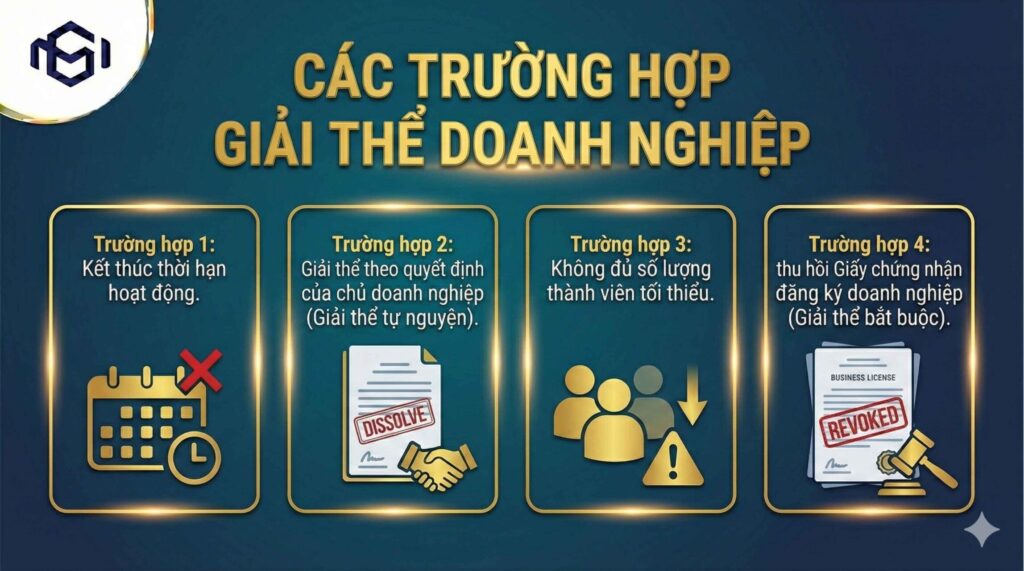
Case 1: Expiry of the operating term
The enterprise is dissolved when the operating term stated in the company charter expires without a decision to extend it.
Case 2: Dissolution by decision of the business owner (Voluntary dissolution)
Due to business difficulties, prolonged losses, or a change in development direction, the business owner has the right to decide to dissolve the company. The specific decision-making authority is as follows:
- Sole proprietorship: By decision of the business owner.
- Partnership: By decision of the Members’ Council.
- Limited liability company: By decision of the Members’ Council or the company owner.
- Joint-stock company: By resolution of the General Meeting of Shareholders.
Case 3: Insufficient minimum number of members
The company no longer has the minimum number of members required by the Law on Enterprises for a continuous period of 06 months without carrying out the procedure to convert to an appropriate type of enterprise.
Case 4: Revocation of the Enterprise Registration Certificate (Compulsory dissolution)
The enterprise has its Enterprise Registration Certificate revoked by a competent state authority (except where the Law on Tax Administration provides otherwise). This revocation means the State no longer recognizes the enterprise’s legal status.
Prerequisites for dissolution
Under Clause 2, Article 207 of the Law on Enterprises 2020, an enterprise may only be dissolved when it meets the following two conditions:
- It has paid off all debts and other asset obligations.
- The enterprise is not in the process of resolving a dispute at a Court or Arbitration body.
In the specific case where the enterprise has its Enterprise Registration Certificate revoked (Case 4), the relevant managers and the enterprise are jointly liable for the enterprise’s debts.
Company Dissolution Process and Procedure (Step-by-Step)
The company dissolution procedure is not just about working with the Department of Finance; it is the process of “closing the door” with all management authorities. Below is the standard 7-step sequence under the 2025 regulations:
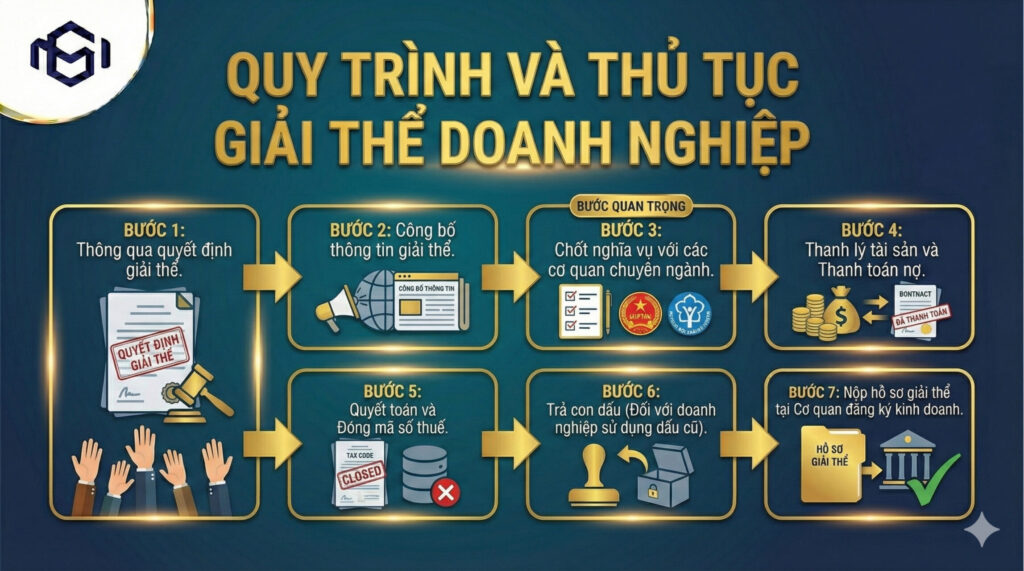
Step 1: Pass the dissolution decision
The business owner/Members’ Council/General Meeting of Shareholders meets and passes the dissolution decision. The decision document must contain the following mandatory contents:
- The reason for dissolution.
- The time limit and procedure for liquidating contracts and paying debts (maximum 06 months).
- The plan for handling labor obligations.
Step 2: Disclose the dissolution information
Within 07 working days of passing the decision, the enterprise must:
- Send a notice to the Business Registration Office (Department of Finance) (https://dangkykinhdoanh.gov.vn) to update the status to “Undergoing dissolution procedures” on the National Portal.
- Publicly post the decision at the head office.
- Send notices to employees, creditors, and persons with related interests.
Step 3: Settle obligations with specialized agencies (Important step)
Before closing the tax code, the enterprise must complete procedures with the following parties:
- Social Insurance Agency: Report a reduction in labor, close the insurance book, and pay off any outstanding social insurance debt (if any).
- Customs Authority: Send an official letter to the General Department of Customs requesting confirmation of no outstanding import-export tax (even if the enterprise has no import-export activity). The waiting time for confirmation is about 10-15 days.
- Bank: Settle and close the bank account (obtain a written confirmation of account closure).
Step 4: Liquidate assets and pay debts
The enterprise liquidates its assets to pay debts in the order of priority prescribed by law in Clause 5, Article 208 of the Law on Enterprises:
- Unpaid wages, severance allowance, and social insurance of employees.
- Tax debts.
- Other debts.
Step 5: Tax finalization and closing the tax code
The enterprise submits the dossier requesting termination of the tax code’s validity to the directly managing Tax Sub-Department.
- The tax authority will examine the books and finalize the tax.
- The enterprise pays all taxes and fines in full (if any).
- Receive the notice that the taxpayer has ceased operations (tax code closed).
Step 6: Return the seal (For enterprises using an old seal)
- If the enterprise uses a seal issued by the Police (before July 1, 2015): It must return the seal and the seal specimen certificate to the Police authority.
- If the enterprise engraved its own seal (after July 1, 2015): No need to return the seal; the enterprise destroys or keeps it under its internal regulations.
Step 7: Submit the dissolution dossier to the Business Registration Authority
After completing the above steps, the enterprise submits the official dissolution dossier to the Business Registration Office. After 05 working days, if the dossier is valid, this authority will issue a notice that the enterprise has been dissolved and remove its name from the system.
Company Dissolution Dossier to Prepare
For the review process to go smoothly, the enterprise needs to prepare a complete and accurate dossier including:
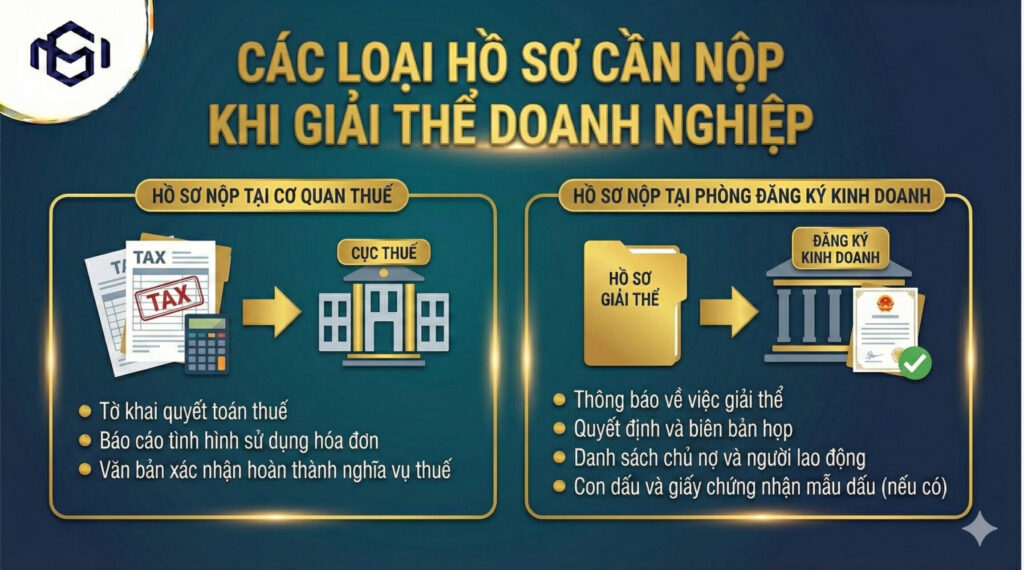
Dossier submitted to the Tax Authority
- Written request to terminate the validity of the tax code (using the prescribed form).
- Valid copy of the dissolution decision and meeting minutes.
- Written confirmation of the completion of customs obligations (from the General Department of Customs).
- Report on invoice usage and destruction of unused invoices.
Dossier submitted to the Business Registration Office
Carried out in accordance with Decree 01/2021/ND-CP and its guiding documents:
- Notice of the enterprise’s dissolution (Form No. 30 – Appendix I issued together with Circular No. 68/2025/TT-BTC).
- Report on the liquidation of the enterprise’s assets; list of creditors and debts already paid (including confirmation that all tax and social insurance debts have been paid).
- Resolution or decision of the company owner on the dissolution of the enterprise
- Seal and seal specimen certificate (if the enterprise must return the seal to the Police).
- Original of the Enterprise Registration Certificate.
- List of employees and the benefits already settled (if any).
- Other documents: Letter of authorization (if submitting on behalf), written confirmation of bank account closure (depending on the specific requirements of each locality).
- Debt settlement plan (if any)
Note: If, after 180 days from the date the dissolution notice is sent (in Step 2), the Business Registration Office receives no dissolution dossier and there is no objection from the parties, the enterprise’s legal status will automatically change to “Dissolved” on the national system.
Rules on returning the seal upon company dissolution
Handling the seal is one of the most common issues when an enterprise carries out the dissolution procedure. Pursuant to the Law on Enterprises 2020 and its implementing documents, the specific rules are as follows:
The right to self-determine the seal
Under Article 43 of the Law on Enterprises 2020, the enterprise has full autonomy over the management and use of its seal:
- Form: The seal may be a traditional engraved seal or a digital signature, depending on the usage needs and internal regulations.
- Quantity and content: The enterprise decides for itself the quantity and form of the seal used for the head office, branches, and representative offices.
- Management: The safekeeping and destruction of the seal are carried out under the company charter.
Despite this autonomy, under Clause 7, Article 2 of Decree 56/2023/ND-CP and Clause 8, Article 70 of Decree 01/2021/ND-CP, the enterprise is required to carry out the seal-return procedure in the following case:
Subjects of application: Enterprises using a seal issued by the Police authority (usually seals issued before July 1, 2015, or seals of special enterprises).
Procedure: When carrying out dissolution, the enterprise must contact the Police authority that issued the seal to:
- Return the engraved seal.
- Return the original of the seal specimen registration certificate.
- Submit a document clearly stating the reason for returning the seal (dissolution) and the information of the person submitting it.
After completion, the Police authority will issue a Certificate of seal revocation. This document is a mandatory component of the dossier to be submitted to the Department of Finance to complete the dissolution procedure.
Note: For enterprises using a self-engraved seal (after July 1, 2015) or a digital signature, the enterprise does not need to carry out the seal-return procedure with the Police authority, but manages/destroys it under its internal regulations.
Common causes leading to company dissolution
Dissolution is a difficult decision, but sometimes it is necessary to end an ineffective operation and preserve the remaining capital. Below are the 5 main causes leading to company dissolution in Vietnam today:
Prolonged business losses (Leading cause)
This is the most common reason. The enterprise operates without generating profit, with continuously negative cash flow, leading to an inability to pay debts as they fall due. When the ability to raise capital is exhausted and the burden of operating costs becomes too great, the owner is forced to choose dissolution to cut losses and stop the financial burden.
Limited management and executive capacity
Weakness in the leadership apparatus is a core cause of an enterprise’s decline. A lack of management experience, risk-management skills, and strategic vision in the Board of Directors causes internal discord and loose operating processes. When the apparatus cannot run smoothly, decline and dissolution are the inevitable result.
Outdated, ineffective business strategy
The market is always changing; if an enterprise lacks a realistic strategy and fails to keep up with trends (such as digital transformation, online marketing, SEO, etc.), it will quickly be eliminated. Failing to invest adequately in product promotion or maintaining an outdated business model causes the enterprise to lose its competitive edge, fail to attract new customers, and gradually lose market share.
Capital shortage and difficulty raising capital
Many enterprises (especially SMEs and startups) often face cash-flow difficulties. A scarcity of investment capital and limited access to bank credit prevent an enterprise from scaling up or sustaining operations when a shock occurs. Over-reliance on external loan capital without financial self-sufficiency often pushes an enterprise into a deadlock.
Impact of macro factors (Economy, natural disasters, epidemics)
Objective factors such as a global economic recession, high inflation, natural disasters, or epidemics are major shocks to an enterprise’s health. These events disrupt supply chains, reduce the market’s purchasing power, and increase input costs. Enterprises with weak resilience that cannot adapt in time are forced to leave the market.
Frequently Asked Questions (FAQ) on company dissolution
Q1: How long does it take to complete the dissolution procedure?
By law, the dossier processing time at the Department of Finance is 05 – 07 working days. However, the actual time usually lasts from 1 to 3 months, or even longer. The main reason is that the enterprise spends a lot of time on tax finalization, explaining figures, and completing its tax payment obligations with the tax authority before being allowed to submit the dissolution dossier.
Q2: Can an enterprise that has not paid off all its debts be dissolved?
No. Under Clause 2, Article 207 of the Law on Enterprises 2020, the prerequisite for dissolution is that the enterprise must ensure it has paid off all debts and other asset obligations (unpaid wages, tax debts, partner debts, etc.). If the enterprise is insolvent (has no assets left to pay debts), it must switch to the Bankruptcy procedure and cannot carry out the dissolution procedure.
Q3: Can a business simply stop operating without carrying out the dissolution procedure?
Absolutely not. If the enterprise arbitrarily leaves its business address without carrying out the dissolution procedure:
- The enterprise will have its tax code locked.
- The legal representative will be put on a blacklist, banned from leaving the country (if tax is still owed), and not allowed to be named as the founder of a new enterprise for a certain period.
- Be subject to heavy administrative penalties for tax evasion and violating business registration rules.
Q4: Distinguishing between Dissolution and Business Suspension?
- Business suspension: The enterprise temporarily halts operations for a certain period (maximum 1 year per time), after which it will resume operating. The legal-entity status remains.
- Dissolution: The permanent and complete termination of the enterprise’s existence. The legal-entity status is erased.
Q5: What is the order of priority for paying debts upon dissolution?
When liquidating assets, the enterprise must pay in the following order of priority (under Clause 5, Article 208 of the Law on Enterprises):
- Unpaid wages, severance allowance, social insurance, and health insurance of employees.
- Tax debts.
- Other debts.
Q6: What does the cost of company dissolution include?
Currently, the State does not charge a fee when submitting the dissolution registration dossier at the Department of Finance. However, the enterprise will incur other costs such as: outstanding taxes, late-payment tax fines (if any), the cost of destroying the seal (if any), the cost of publishing the announcement, and legal consulting service fees (if an external firm is hired).
Q7: While undergoing dissolution, can the dossier be withdrawn to resume operations?
Yes. Before the Business Registration Authority updates the status to “Dissolved” on the National Information System, the enterprise may submit a dossier to cancel the dissolution decision and return to normal operations. However, the enterprise must carry out the procedure to restore its tax code with the tax authority (if it has been closed).
CONCLUSION
Company dissolution is a complex procedure with many legal risks, especially in the tax finalization stage. Even a small mistake can result in the legal representative being banned from leaving the country or bearing personal asset liability.
To make the process of closing your business fast, lawful, and absolutely safe, contact MGI Consulting right away. We provide a full-package company dissolution solution, handling the entire dossier on your behalf, from Tax and Insurance to the Department of Finance.
MGI support service details: Company dissolution service 2026